I love Monster Hunter. The concept of testing one’s mettle against prehistoric dinosaur/beast/dragon-thingies physically excites me not unlike a private eye who just bought his first blacklight. I enjoy gunning giant fire-breathing dragons clean out of the sky, and I revel in the satisfaction of driving suitcase-sized hammers into the faces of stampeding T-rexes (especially when the beasts are impotently flung into stalagmites while Looney Toons-esque stars swirl over their heads). Conceptually, Monster Hunter is one of the most brilliant games to have ever graced my PS2, Wii, 3DS, and PSP.
I’ve wasted devoted well over 3,000 (not a typo) hours to this series, spanning across eight years and nine games. In this community that number is (bafflingly) somewhat conservative, but needless to say, I know the games pretty well. And yet, despite (or perhaps because of) my undying love for this series, I must admit that it hasn’t evolved all that much, since I first moved to Minegarde nine years ago.
これは なん ですか: The Abridged History of Treading Prehistoric Water
Note: I'm about to recount the history of this franchise from a player's perspective. If you don't want to read my description, Tvtropes has its own serviceable one, that also highlights the ludicrous popularity of this franchise. Pick your poison.
In the original Monster Hunter you fought dinosaurs, wyverns (slightly smaller, armless dragons), a unicorn, and two dragons; skinned them; made weapons and armor out of their dangly parts; and repeated until carpal tunnel prevented you from making the idiotic claw motion with your fingers. There were other smaller quirks, like an extremely rudimentary fishing system and gun customization, but the bulk of the experience laid in monster killing. It was undeniably simplistic, but brimming with potential for evolution and expansion.
Unfortunately, the second Monster Hunter (appropriately titled Monster Hunter 2) didn’t add any new mechanics or redefine the original’s gameplay progression. But, it did expand the existing mechanics, which at least somewhat minimized the game’s repetition. The first game had six weapon types (seven if you want to separate the two bowguns) and the second game added four more in addition to some new moves to the original six. The first game had five areas. The second game added one more and changed an existing one. The original game had 17 boss monsters while the second one added 12 more.
Other than the much appreciated refinement to the armor and weapon customization, nothing else changed in a way that significantly altered the game. In fact, because of how little the game changed, Capcom allowed players to import literally all of their possessions from MH1 to MH2. But, while respecting the hundreds of blood soaked hours sunk into the first game was a very generous gesture on Capcom’s part, the fact that transferring everything was even possible only highlights the fact that the game was more akin to an expansion pack than a full blown sequel. This is doubly problematic in that Capcom STILL had the balls to charge full price for Monster Hunter Freedom 2 and $30 (75% of full price) for its official expansion Monster Hunter Freedom: Unite (also note that Monster Hunter 2 was not released outside of Japan, so MHF2 is the western equivalent to Monster Hunter 2, albeit with slightly fewer monsters). It wasn’t until the third Monster Hunter game (Monster Hunter Tri) that Capcom finally elected to make some more appreciable gameplay changes.
The first and most obvious change was the inclusion of underwater combat (which is just as difficult and far less interesting than it sounds). For the first time hunters could chase that giant scaly bastard Plesioth into its den of hip checking despair, as opposed to fishing it out with frogs like a coward. Logically, to ensure that players would actually have more to do with this mechanic than exact retribution on the most infuriating monster of the past two games, it was accompanied with a new variety of primarily sea-dwelling leviathan monsters. These creatures, while limited in diversity and clearly delineated in terms of dangerousness, were an extremely welcome addition to a game whose monster total rapidly dwindled from its predecessor (more on this in a moment).
Series veterans however, would likely have taken greater notice of the aesthetic and mechanical changes to the older monsters. Tri not only introduced 15 new boss monsters, but altered (sometimes significantly) the abilities and attack patterns of classic monsters like Rathalos and Diablos to more closely match their ecological background and lore. What’s more, Tri also introduced a fatigue system that caused monsters to tire out as a fight progressed like the player. This established greater parity between the monsters and the player(s) while also making the beasts a bit more realistic than the indefatigable killing machines of prior titles.
Lastly, and most significantly, MH3 reset the player canon. The franchise jumped platforms from Playstation to Nintendo, the art style became smoother and more vibrant, more than half of the older monsters and four weapon types were removed (though one new one was added), and for the first time in four games, players could no longer carry over their hunters and gear from previous games. Tri was simply a different game, and while critics and newcomers were more open to Tri than any of the previous titles, old fans did NOT appreciate the lack of content relative to MHFU (especially considering that Tri was released on a more powerful platform with four times the disc space of Unite). Perhaps in response to the fan disappointment, Capcom went back to the well and resurrected many of the older monsters and all of the old weapon types in the most recent western title, Monster Hunter Tri: Ultimate. Like Unite before it, MH3U is the most complete Monster Hunter game to date (west of the Pacific) and the only one worth playing.
Those are the basic cliff notes of Monster Hunter’s iterative history. However, the series’ glacial paced evolution is not one of the back-breaking straws that damned it to critical disdain early in its lifespan. That pleasure belongs to its astonishing amount of tedium, a lack of respect for the player’s time, monotonous hunting scenarios, and astonishing unfriendliness towards newcomers. Despite developing over 10 games in this franchise and regularly updating an MMO, Capcom has yet to completely address ANY of these problems, so since we can't rely on them to do their damn job: let’s fix Monster Hunter.
#1 “Isolate the variables in the game that impede the player’s enjoyment. Then, list alternatives to each variable that emphasize the experience of hunting while minimizing its frustrations.”
Anyone who has played a Monster Hunter game long enough to have fought a wyvern can probably recount at least a hundred thousand times that they've felt “screwed over” by the game. In action games, this is generally the result of either poor camera angles/controls, nonsensical gameplay mechanics, an unfair boss/enemy attack, and or unresponsive movement controls. Monster Hunter contains not one, not two, but all of these degrees of bullshit. The most infamous and blatantly egregious of these problems is the camera, so it behooves us to address it first.
Fix #1: The Goddamn Camera
The Monster Hunter games could be classified as “character-action” games. They all feature a third person camera and place a high gameplay emphasis on un-cancellable player character animations. In order to convey the most useful information to the player without displaying obtrusive UI additions, character-action games either contain a free camera that allows a player complete control over the X and Y axes (DmC, Bayonetta, Toukiden) or fixed camera angles that attempt to provide a full view of the action (e.g. God Hand, most of Devil May Cry 3, etc.). Naturally, each camera set-up comes with its own set of advantages and disadvantages.
The fixed camera provides less specific information about individual obstacles, but can better enable players to react to enemies outside of their avatar’s field of view. The free camera does the opposite, allowing for more detailed information about whatever target the player chooses to focus on, but no information about targets outside of the camera’s field of view, and thus forcing more interaction from the player. While I prefer a free-camera angle in character-action games, they both work in effectively establishing a lovely player-camera relationship that is immediately understandable and assists the player in playing the game.
The fixed camera provides less specific information about individual obstacles, but can better enable players to react to enemies outside of their avatar’s field of view. The free camera does the opposite, allowing for more detailed information about whatever target the player chooses to focus on, but no information about targets outside of the camera’s field of view, and thus forcing more interaction from the player. While I prefer a free-camera angle in character-action games, they both work in effectively establishing a lovely player-camera relationship that is immediately understandable and assists the player in playing the game.
And yet, for reasons that only one of the game’s designers can understand, the Monster Hunter games hybridize the two types of cameras by possessing a set of fixed camera angles along the y-axis that a player can rotate a full 360 degrees along the X-axis. It’s impossible to guess which came first, the utterly ridiculous camera or the bizarre control scheme that necessitates it, but the odd camera set-up has the negatives of both of the camera types (limited FoV and frequent camera adjustment) without the advantages of either (a complete view of the action and full control over the camera). In short, the camera in Monster Hunter games actively works against the player.
As annoying as that can be in a character-action game, it can still be played around provided that the player has any degree of control over the camera. But, as no good opportunity can go untainted in this franchise, Monster Hunter is also plagued by a series spanning issue with camera controls.
As annoying as that can be in a character-action game, it can still be played around provided that the player has any degree of control over the camera. But, as no good opportunity can go untainted in this franchise, Monster Hunter is also plagued by a series spanning issue with camera controls.
On the Playstation 2 where the series originated, the right analog stick issued one of four attack commands depending on which of the four cardinal directions the player tilted it (Note: the attacks don’t actually correspond to the four directions, Capcom just wanted a way to input four separate attacks without using all of the face buttons). This was dumb. Not only did it prevent Capcom from using the second analog stick to move the camera (as it has in every other game with a 3rd person free camera since the PSX era), it forced them to use the shoulder buttons to move the camera horizontally, thus necessitating the creation of the limited-free camera (LFC) (yes, that’s what we’re calling it now) with a locked y-axis.
Almost anyone who has played a character-action game can tell you that the LFC was/is a bad idea for many reasons, yet ironically the invention of the LFC actually worked to Capcom’s advantage when they moved the series to the PSP and 3DS; consoles without a second analog stick. Most of the skills developed by early adopters of the franchise cleanly carried over from the PS2 to the PSP and 3DS as the control scheme didn’t change very much outside of the attack commands. But, as anyone who has seen a 3DS or PSP before can attest, moving with the left analog stick while simultaneously adjusting the camera with the d-pad is cumbersome,


uncomfortable

and unintuitive

When Monster Hunter moved to the Wii, the controls took yet another understandable, but serious nose-dive in usability. It was however, (arguably) compensated for with the inclusion of the classic controller pro that was bundled with every new copy of the game (and added $10 to the price tag). Capcom consequently enabled the second analog stick to control the camera and included an option to use the classic PS2 controls for people with severe mental disorders veterans and Lance users who wanted to counter attacks properly. However, despite the change in camera controls, the camera was still bound by the LFC, nullifying the advantage of the second analog stick and proving that Capcom didn’t actually understand the spirit of people’s criticism.
And yet, despite Capcom’s floundering for the past decade, this is actually not that daunting of an issue to solve. As I said, most character-action games (even those developed by Capcom, hilariously) addressed their camera woes during the PS2 era, so solutions to this problem are not at all difficult to come up with.
Answer A. Add a true lock-on button
MH3U employed a half-measure towards implementing a lock-on system by allowing players to make pressing the left bumper focus on the Monster. This was actually a very nice addition to the game that made keeping the camera focused on fast moving targets like Barioth and Nargacuga noticeably easier. But, at best the focus button has a tendency of losing its target, and at worst it's prone to flailing the camera about uncontrollably. A full measure answer to the camera is to simply go the way of Demon’s Souls and include a true lock-on button. Make pressing the left bumper lock-on to the nearest monster and include an option to enable the lock-on to lock to the nearest boss monster instead. This implementation would not require anything else in the game to change and would drastically mitigate the burden placed on players' now withering index fingers.
A good lock-on system also requires some means of shifting the target to different monsters (unless people just enjoy toggling the lock-on, moving towards what they want to target, and pushing the button again as if they were an OCD stricken George Jetson). Because the Monster Hunter games predominantly exist on handhelds now, the easiest means of doing so is to allow the right bumper to shift between targets when locked on. The player’s index finger should already be resting there, and while locked-on the button would lose its functionality, so this is literally the most readily available means of switching targets. Capcom has no reason not to implement this lock-on system or something similar to it aside from a base fear of pissing off elitist veterans claiming “lock-on is EZ mode.”
Answer B. Add a “smart” camera
A smart camera focuses on significant areas of the combat without the player’s input. It is ostensibly a variant of the fixed camera, but is better suited towards movement in 3D space as it adjusts itself as the situation demands. Again, this solution reduces the player’s need to constantly adjust the camera and would not affect any other aspect of the game. However, this solution has the caveats of fixed-camera systems in that it limits the player’s control over the camera. It is still definitely better than the hot garbage that is the LFC, but it has its own share of warts as well.
Answer C. Add limited “smart camera” functionality AND a lock-on button
Smart cameras aren’t necessarily limited to auto-focusing on set pieces. They can also be used to zoom the camera in and out automatically if the player moves too close to a large object. From Monster Hunter 2 onwards, the MH games have all employed camera functions resembling this. But, they never serve much practical purpose, since they only trigger when the player has been knocked into a corner, and not when he walks or runs into one. So, you can see the giant monster as it grinds you into tiny kibbles, but you can’t actually do anything about it (more on this in a moment).
The specific functionality of this solution is to have a lock-on button that forces the camera to stay focused on a monster, as well as a smart camera that zooms out if the lock-on system does something stupid (like obscuring the player’s vision of their character in order to show off an adjacent monster’s spectacular arsehole). Essentially, this is just a more nuanced lock-on system. Any sort of lock-on system would be an improvement, but this system would make the camera more overtly “helpful” as opposed to simply being unobtrusive like that of Answer A.
Answer D. Unlock the Y-Axis (use a free camera)
A free camera, while not perfect, would at least allow a player complete control over the action and put the power in their hands, rather than the fumbling ones of the game. Ironically, Tri added the free camera for underwater combat, as players could move and be attacked along the along the entire X,Y, and Z-axes, but for some reason this wasn't transferred to the ground combat, and instead adds to the learning curve of fighting underwater. Other actions games like Bayonetta and DMC4 have demonstrated that this works. Again, there's no reason other than the appeal to tradition not to do this.
Answer E. Unlock the Y-Axis, add limited “smart” camera functionality, AND add a lock-on button
And finally we, have what I think is the best answer: a free camera with all of the perks of Answer C. For those familiar with the title, this is Dark Souls 2’s camera. As much as I despise Dark Souls 2, one phenomenal aspect of that game was its camera. It was unobtrusive, followed the action clearly, has smooth transition between lock-on targets, and lets the player move it wherever they damn well please when it’s not being so amazingly friendly. I love this camera, and Monster Hunter is a franchise that would greatly benefit from borrowing this gem from its RPG brother in arms.
I don’t see any other obvious solutions to the camera issue that wouldn’t compromise some aspect of the core Monster Hunter experience, but if you have any other suggestions let me know.
Now the camera, while important, is not quite as significant as what’s in the frame. Because this is supposed to be a game about hunting monsters it behooves Capcom to make doing so an engaging experience. Unfortunately, the monsters themselves are also bogged down with their own special brand of lingering bullshit, the most notorious of which being their hitboxes.
“Of Hip Checks and Hitboxes”
Let me you a tale of hip checks and hitboxes. Many moons ago, when gods and kings defiled the earth and rubber turkeys soared across milky skies, there existed a man; a monster hunter, who sought after a fish. But, this was no ordinary fish. This fish was larger than the tallest of elephants. This fish could swim faster than the swiftest of dolphins. This fish ate frogs. The leviathan only dwelled in the deep dark caverns beneath a desert oasis, so after strenuously plucking three of the most succulent caecilians from a nearby pond, the hunter trekked across miles of scorching sands toward the sea-beast’s lair. Being an adept hunter, he expeditiously identified its lair and traversed its depths to gaze upon the unholy creature. “PLESIOTH!!!” The hunter roared. “YOUR END HAS COME.” Armed with his trusty nameless fishing rod, he cast the first frog into the watery abyss. Within moments the line was caught and the monster was grounded. It floundered helplessly for a few moments, affording the hunter precious time to prepare his trusty crossbow, Maelstrom.
Recall, this was before the invention of bows and arrows, so hunters needed to rely on their primitive gunpowder-based crossbows and bullets to slay these titanic primeval monsters. But, I digress. With Maelstrom fully loaded and Plesioth finally finding its footing, the hunter brandished his bowgun and fired a torrent of lightning-laced shells deep betwixt the serpent’s emerald scales. Alas, though it flinched, it did not fall. Rather, it curiously walked in place with its large webbed feet, taunting the hunter with its ignorance. But before the hunter could finish preparing another volley of bullets, the beast turned. The hunter stood several paces from the beast’s body, yet its tail still managed to strike the hunter deeply with a sort of phantom force.
Dazed and terrified by this inexplicable phenomenon, the hunter deliriously shoved the last rounds of ThndSht into Maelstrom and cried out in pain as he loosed his second round. This time the monster did not flinch, but grew angry; very angry. Bubbles frothed from the beast’s mouth as it eyed the hunter with the cold calculating rage of an acrimonious seagull. It leapt to the moist cave floor, wriggling along its great white belly towards the now sprinting hunter. He darted along in a serpentine fashion, anticipating that his erratic movement would thwart the seabeast’s charge. Yet, though the monster and the hunter were separated by over a meter of distance the same phantom force struck with deadly precision, knocking the hunter within arm’s length of the waters below. It was then that the hunter realized, this aquatic horror did not have mortal hitboxes. These were the hitboxes of a demon.
Though the hunter’s body had survived the onslaught, his iron-forged spirit had finally broken. And so he stumbled to his blood-soaked feet and hobbled away to the mouth of the cave. But the beast was not so content to let the worm crawl away. Its bloodlust roused by the hunter’s irreverence had driven it to a madness far beyond that of any normal fish; after all, this fish ate frogs. It crouched like a leopard preparing to pounce, and thrust its massive hip in the hunter’s general direction. The hunter ran as fast as his enervated legs could carry him, but he knew it mattered not, for no man could outrun the devil’s hitboxes. Though the hunter had created a good three meters between his withering frame and the blusterous monster, he felt the weight of a mountain crash into his spine and flew another ten paces forward into the scorching sands. The light faded from the hunter’s eyes as he fell, and never returned. I was that hunter. And that was the day I learned that Monster Hunter is fucking broken.
Fix #2: Hitboxes
For those too lazy to read the provided Wikipedia entry, a hitbox is the invisible physical object that registers object collisions. In Monster Hunter and other games with melee combat, hitboxes are critical as they determine whether or not an attack hits or whiffs. Ideally, the hitbox should conform to the physical shape of the object it surrounds (i.e. the hunter, weapons, and monsters). This way the player can visually identify whether a move should connect and doesn’t feel inclined to throw their console down several flights of stairs or sigh with exasperation. But, hitboxes in Monster Hunter have never lived up to the standards of fairness.
The first two generations of games were well known for their “broken” hitboxes with phantom hits and cries of bullshit being the standard fare for veteran hunters. Ironically, I feel that the appearance of the game blatantly cheating contributed to the feeling of satisfaction upon slaying monsters. Though that doesn’t excuse the fact that the hitboxes were less sensible than the phrase “military intelligence” (references!). The sea-demon of my
To be fair, upon MH3’s release Capcom fixed the majority of the monster hitboxes so, this is really just an issue relating to specific attacks by specific monsters (and any new monsters they happen to concoct for MH4).
Answer A. Make the hitboxes closely conform to objects’ proportions
This one is a no-brainer that people have been clamoring for since the first game. It makes sense logically, and there isn’t a good reason not to implement it. Though, mind you, there IS likely a reason why some monster hitboxes are still unfair. The fact that Capcom had revised most of the hitboxes for Tri, but not others demonstrates that they must have considered those “less-visually-accurate” hitboxes fair. However, as someone who strongly dislikes getting tail-whipped by air, I don’t think this is the way to go about establishing difficulty. If Capcom is worried that their monsters’ attacks are too easy to avoid then they should adjust the animation itself, not widen its hitboxes. Unfortunately, Capcom (as well as another notable studio) has a long track record of borking that up as well.
Fix #3: Animations
Difficulty in 3rd person action games hinges on striking a delicate balance between 2-3 systems (in addition to damage systems): animations (speed), recovery, and usually staggering/interruptions (MH uses all 3). Generally, a player with fast animation speeds, low recovery times, and an inability to be interrupted make a game easier, while enemies possessing those same traits make the game more difficult. Balancing these games then, entails finding a way to confer some (or both) of these benefits to the player and the enemy in order to create a fair difficulty setting. Monster Hunter balances these mechanics (loosely) as follows:
1. Any physical and some gaseous attacks will interrupt the player
2. Each monster has an invisible stagger threshold that, when reached, will stagger the monster and reset
3. Any damage a monster sustains also damages its stagger threshold by a proportional amount
4. After a monster sustains enough damage, its attack animations temporarily become faster
5. Certain monster tails can be cut off, shrinking its hitbox
6. Player attack, dodge, and guard animations cannot be cancelled by the player
7. Certain monster attack animations can be cancelled by the monster
Going off of that list alone, you might (accurately) guess that Monster Hunter is pretty hard (and even harder when you consider that it only takes around 3 hits to kill a hunter, but about 90+ to take down a boss monster). For those unaccustomed to these types of games, the inability to cancel animations often serves as the largest hurdle, since it ostensibly forces the player to “commit” to each action, and implicitly demands that one plans each move in advance. One would think that this would make for a more strategic game, however, due to the monsters' odd response timings and high stagger resistance, the player experience is more accurately summarized by the phrase “don’t get greedy.”
All of the monster’s advantages, however, are “balanced” by their stupidity and predictability. The challenge of these games does not usually boil down to masterful execution or superior preparation, but mindless pattern recognition. This is lazy game design. If the monsters could react more realistically and didn’t arbitrarily waste time, the player would never stand a chance. Therefore, the most sensible means of mitigating a player’s frustration (and likely boredom) without reducing the game’s difficulty is to bring more balance to the player-monster interplay.
Answer A. Increase the responsiveness of both hunters and monsters, while lowering monster stagger thresholds.
This answer primarily mitigates the difficulty of playing a game with un-cancellable animations by allowing for more opportunities to initiate a different action (like a dodge roll). What's more, it also conveniently doesn’t require much work, since Capcom can easily allow for dodge rolls during certain attack frames (particularly during most of the Dual Swords, Hammer, and Sword and Shield attacks). And, if the same treatment is given to monster attacks, then the player will have an increased reason to exercise that freedom (after all, a hip check really, really hurts). The key to balancing this solution, however, is in that final clause.
Lowering the monster stagger thresholds is absolutely critical as it allows either the monster OR the player to dictate the flow of the battle instead of solely one party (read: the monster). In other words, a battle with a monster will actually feel like a battle, flowing smoothly between its combatants, as opposed to a primarily static war of attrition, as is currently the case.
Answer B. Tie the
monster stagger threshold to the weapon/item class instead of damage
A heavier weapon should stagger an opponent faster than a lighter one. Period. The gameplay mechanics are already (mostly) balanced around this relationship wherein weapon swings from large weapons are slower, but more powerful than those of small weapons. However, if a weapon is strong, then it will stagger a monster regardless of the weapon's size, making absolutely no sense whatsoever. Aside from the logical reasons to use this system, from a gameplay perspective, it would also establish a more natural flow to the combat that would adjust according to the player’s choice of weaponry and tenacity.
This is mostly in place already, as weapons with a higher damage output (generally, the larger weapons) will stagger monsters faster than those with lower damage outputs (smaller weapons). But, the main advantage to genuinely tying staggering to the weapon class is to allow players with un-upgraded weapons to still have an engaging fight with monsters outside of their weapon’s rank (damage range). As it stands, whenever a hunter advances through the ranks, she has to immediately make a stronger weapon to fight effectively. With this system in place, the only difference between a strong weapon and a weaker one is the time it takes to bring down the monster, i.e. player skill takes the center stage instead of numbers.
Naturally, if mishandled this
solution leaves room for a serious balance issue, where hunters could simply
leave with four greatswords (very-heavy weapons) and absolutely decimate a monster
without giving it a chance to react. However, this isn’t all that
different from the way things are now (a 4v1 fight just isn’t going to be fair
no matter how you slice it), and if coupled with Answer A, the monster could
simply be scripted to use area attacks and guerilla tactics with greater
frequency, proportional to how many hunters are in its arena/nearby. It’s not a
perfect solution, but it gets the job done.
Answer C. Change the attack animations of both the players and monster in order to give the combat a “rhythm”
Answer C. Change the attack animations of both the players and monster in order to give the combat a “rhythm”
Primarily
aimed at monsters, this solution seeks to make the player and monster attacks
easier for both parties to respond to, similar to a fighting game where both
fighters are on equal footing until one of them gets a frame advantage. This would, again lead to more dynamic hunts and
inspire more creativity on the part of the player. Note that it is also extremely difficult to implement this
properly without redesigning every single attack animation in the game, so it
is by no means recommended unless Capcom is ready to reinvent the series (fat
chance).
Answer D. All of the above
Again, I feel that this is the best option, and ironically it’s less difficult than focusing on Answer C alone. Melding Answers A & B together such that the player and monster can both respond to each other’s attacks, while simultaneously increasing the value of each hit, naturally produces Answer C regardless, so getting the benefits of all three Answers instead of one seems like a no-brainer. Above all, this and the preceding answers all lead to a game that is more fluid and, more importantly, fair than the current game.
Fix #4: Weapon Damage
With most of the monster issues addressed, let’s switch perspectives and look at weapons a little more carefully. To further the semi-realistic feel of the hunting experience, Monster Hunter games hide the health of each monster. While it can be potentially annoying for a player who is mainly interested in fighting, the feature effectively encourages players to observe the monster’s behavior carefully for clues about its health condition. I love this feature. However, it does come with the caveat of masking the strength of each individual weapon.
Every weapon has a power rating displayed in the game. However, that number is actually completely misrepresentative of the weapon’s actual damage output. It varies from game to game, but each weapon’s strength is actually calculated by factoring the power displayed through a series of multipliers that determine the damage it actually inflicts on a given swing. To demonstrate just how different the displayed power is from the actual weapon damage let’s compare the damage output of two weapons with similar power ratings, but different weapon classes in MH3U:
Answer A pt.2: Eliminate weapon sharpness degradation
entirely.
In MH, weapon sharpness deteriorates over time in order to balance melee weapons (with infinite uses) against the various projectile weapons with finite ammo. To circumvent this, hunters can restore their weapon’s sharpness with a whetstone, incapacitating them for about six seconds. the hunter will almost certainly be hit by an impatient monster. Giving melee weapons a maintenance cost to briefly take them out of combat, like the ranged classes was seen as sufficient. Unfortunately, this was a dumb means of establishing parity since ranged weapons generally kill faster than melee weapons, and any gunner worth his salt always carries enough ammo to see the mission through to completion. So, this “balancing mechanic” really only adds an annoyance to playing as a blademaster (melee weapon user) and further exacerbates their already inferior performance.
Plus, there’s almost no actual logic to the system. If your weapon starts breaking after 20 minutes of use a. it’s probably not particularly well-made and shouldn’t be used to hunt giant angry dragons and b. you would not be able to sharpen it (especially a fucking hammer) by stoking it four times with an invisible rock. Eliminating weapon degradation has almost no effect on the game whatsoever outside of making blademasters’ gameplay experience a little less tedious.
To clarify, Capcom should allow hunters to take multiple weapons on a hunt and swap them out at the base camp. While this doesn’t directly circumvent the sharpness degradation issue or provide more information on weapons, it furthers the same goal and assists hunters in understanding monster behavior, by encouraging them to try different attack styles as the hunt progresses. Not only would this change make sense from a lore perspective, as the hunter’s guild both transports and supplies hunters, usually via boat, but it would also give hunters a reason to go back to base camp of their own free will, providing much needed breathing room in a game that these changes will unquestionably make much faster.
It’s also worth noting that this change would bring fairness to marathon hunts (where hunters fight a series of monsters, usually with different elemental weaknesses) and open the door or more dynamic monster design, as monsters could have limbs and shells with a specific weaknesses that could be broken to uncover parts with a different weakness.
At the same time, however, that dynamism might also inspire Capcom to brew some brand-spanking new bullshit by forcing the player to run all the way back to camp whenever a monster part breaks, so understand that the point of this change is to allow and encourage players to experiment with different combat approaches on a single hunt instead of multiple quests. Lord knows, no one wants to waste even more time in this asinine franchise doing nothing.
And while that last sentence would have been the PERFECT transition into talking about how Monster Hunter absolutely loooves wasting player’s time, we still have one last piece of frequently criticized, but never once alleviated bullshit to fix: the goddamn-mother-fucking excessive item penalties.
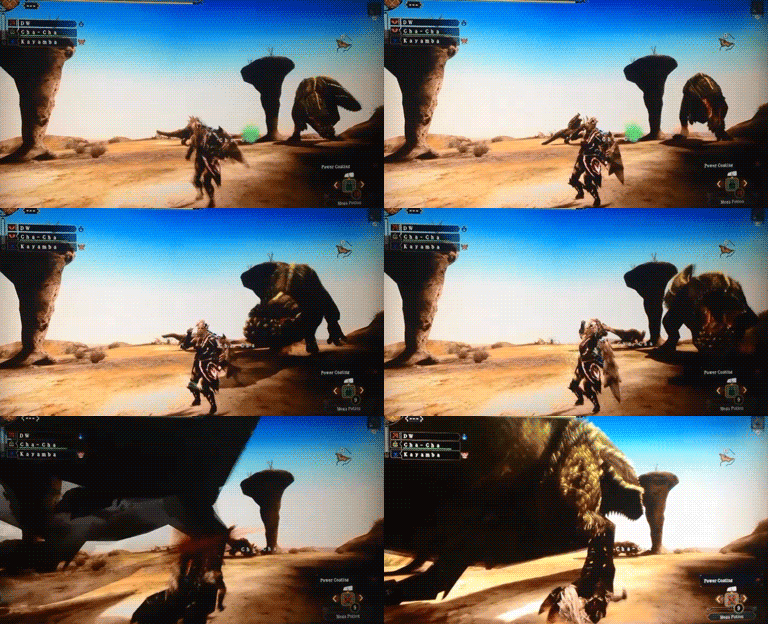
As I mentioned before, sharpening weapons takes quite a few in-game seconds to pull offand makes less sense than a
pogostick that swims across smells, but that’s not the only item that has
an unreasonably long delay. Every item that a player eats or drinks (i.e. the
ones you’ll be using 80-90% of the time) has a 1-3 second animation of the
player ingesting the item followed by another 2 second animation of the player
posing like a vainglorious thirteen year old who just did his first ten big-boy
push-ups. During both animations the player cannot move and like seemingly
every contrivance balancing mechanic in this game, it makes absolutely no
logical sense and completely misses the point of its implementation.
Clearly, Capcom wanted the series to be difficult ("challenging" implies a degree of fairness was considered), so they penalized restorative item use to discourage players from using it as a crutch. What they failed to grasp was that by making the penalty for using such items so severe yet paradoxically making healing items so abundant, players would instead learn to either heal when they would be attacking with "mixed results" (read: repeated failure), or leave the area, heal, and resume the fight (monsters are too stupid to pursue players or retreat when they leave).* In both cases, experienced players are almost completely unimpeded by the penalty. Meanwhile, newbies who will almost invariably attempt the first option, and get punished for it, will instead learn to use healing items as a crutch due to their volume. Both cases directly oppose Capcom’s intention.**
In short, the penalty just makes the game a little more annoying and gives the player yet another thing unrelated to the monster to think about while they are fighting. Once again, fixing this is pretty easy, and like most of the other solutions, other games have already implemented far more sensible solutions to this issue.
Another game probably did it first, but this solution was most notably used in Dark Souls 2 with its Lifegem items. A player could initiate use of the item and while the animation was playing out, the player could walk around slowly, ideally evading attacks with light tracking like projectiles. In Monster Hunter, slowing the player down to walking pace while chugging potions, and jogging pace while using other items like throwing knives and flash bombs would still penalize the player for using items, but would (once again) be more fair and sensible without reducing the game’s challenge.
Despite how many thousand words it took to actually cover all of those fixes, there are still more measures that could be taken to level this franchise’s mountain of bullshit. Most of these issues will be addressed in upcoming sections where they are more directly relevant, but some will not. But, with that said, implementing the changes I’ve suggested thus far would collectively eliminate the artificial difficulty flavorings baked into the game’s combat mechanics, and enable players to FINALLY just play the damn game. Consequently, eliminating the bullshit in the combat mechanics would also draw attention to the game’s other main offense, cruelly disrespecting the player’s time, so that should probably get fixed next.
Because there’s no level-progression, however, a player character never actually grows stronger. Instead, to keep with the theme of creating asemi-realistic hunting
experience, you fight monsters to make equipment, which you use to fight
increasingly powerful monsters and make increasingly powerful equipment. There’s
no real end to the game and there’s no timeframe in which the player must do
something. This is all well and good as it affords players some degree of
control over their progression through the game, but it also ties the player’s
progress to their ability to acquire phat lewt, which is where Capcom commits
empathetic genocide, and gives players the
metaphorical middle finger.
Prior to leaving for a hunt, the hunters time at a small village. At the village one can reequip oneself, manage their items, forge new armaments, buy items (ammo, ingredients, potions, etc., but not monster parts), dispatch hunters on quests, purchase a meal to raise his or her parameters before a hunt, visit the farm gather ingredients, and dispatch fishermen to gather non-essential items and ingredients. In MH3, one can also leave the village without a quest to go Free Hunting and kill some smaller monsters in addition to a variable boss monster.
Surprisingly, the outside activities have actually changed appreciably between MH3 and the previous two numbered games. In MH2 you could also hire chefs to prepare up to 10 well-done steaks (an essential quest item for the more advanced quests) for you so that you wouldn’t have to spend ~6+ minutes making them yourself during a quest. I have no idea why this feature was removed, but what resulted was a slightly more annoying Monster Hunter experience.
Additionally, the farm in MH2 & MH1 used to allow hunters to gather resources (herbs, mushrooms, stones, insects, etc.) outside of quests so that they wouldn’t have to go gathering while on the clock. Once again, for unclear reasons, this feature was removed, or rather marginalized via the newfucking useless fish mongress. Though unlike the steak preparation which has literally nothing to compensate for its loss, the farm system retained its passive item gathering capability, ensuring that hunters at the very least, don’t have to farm (ucwutIdidthar?) for common quest ingredients, like herbs and flashbugs. It was objectively better before, but it’s not completely offensive as it stands. This passive item generation however, highlights one of the smaller overarching issues that could stand to be cleaned up: there’s very little automation, and a little too much micromanagement.
Though every Monster Hunter game is home to a wide variety of mechanics (fishing, cooking, bug catching, mining, etc.), they are not the focus of these games, and are not why people choose to play them. So consequently, it was not only convenient, but sensible for the earlier titles to place these systems in an environment that was at once: risk free, non-essential, helpful, and omnipresent, so that a player could constantly be reminded of these mechanics’ existence, and have a light incentive to engage with them at their leisure. These 3rd generation titles, however, have lost sight of that idea and eliminated the omnipresence of these features in favor of automation. I’d collectively chalk this up to Capcom finally acknowledging the first sentence of this paragraph, but the poor application of these new automated systems and simultaneous removal of existing ones (cooking) depreciates the benefits of the new automated features (focusing the player's attention on hunts) without addressing any of the problems of the manual systems (excessive micromanagement).
III. Attack frame commitment etc.
Every weapon has a power rating displayed in the game. However, that number is actually completely misrepresentative of the weapon’s actual damage output. It varies from game to game, but each weapon’s strength is actually calculated by factoring the power displayed through a series of multipliers that determine the damage it actually inflicts on a given swing. To demonstrate just how different the displayed power is from the actual weapon damage let’s compare the damage output of two weapons with similar power ratings, but different weapon classes in MH3U:
Weapon A Weapon
B
Name: Red Bludgeon+ Soul
of Prominence
Class: Hammer Lance
Attack: 780 621
Element: 160 FIRE 250
FIRE
Sharpness: Green White
Rarity: 4 9
Despite the fact that “Soul of Prominence” sounds infinitely
more badass than “Red Bludgeon+,” Weapon A has about 15% more Attack, but
around 40% less Elemental power than Weapon B. If we were to add the Attack and Element
of each weapon together Weapon A would have 940 total damage and Weapon B would
have 871 total damage. At a glance, weapon A looks a little stronger than
weapon B. But, what if we applied a specific attack modifier to each weapon’s
Attack rating?
Standard attack (single X button press on a 3DS)
Weapon A Weapon
B
780 x 52%= 405.6 621 x 23% =
142.83
The numbers are now empirically smaller than those listed,
but weapon A is significantly
stronger than weapon B. What about if we factor in sharpness as well?
Weapon A Weapon
B
780 x 52% x 1.05= 425.88 621
x 23% x 1.32 = 188.5356
Sharpness: Green White
Now the weapons are a tiny bit closer to together in strength, but weapon
A is still more than twice as powerful as weapon B. Well, let’s factor in the
weapon class modifiers as well, and see what we get.
Weapon A
(780 x 52% x 1.05)/5.2 = 81.9
Weapon B
(621 x 23% x 1.32)/2.3 = 81.972?!
And now, against all logic, weapon B is somehow slightly
stronger than weapon A!?! There are more variables to factor in of course, like
where the attacks land and how resistant the target is to the damage type, but
given that all things are equal and both weapons hit the same spot with their
respective standard attacks, B will do more damage than A despite it appearing weaker on the in-game menus.
While I don’t have a problem with the notion that a lance can
be more powerful than a hammer, I take serious issue with the fact that nothing
in the game itself makes this numerically apparent outside of their vast gulf
in rarity. In order to minimize the occurrence of the question “WHY WON’T THIS
SCALY BASTARD DIE!?!?” Capcom needs to un-complicate displayed
weapon power. And, thanks to the associative property of multiplication, this
is extremely easy to fix.
Answer A: Pre-calculate the weapon type and element
dividers, and surface or explain the sharpness damage modifier.
This is basically, a hotfix that a decent modder could apply
within a few hours. The weapon type is typically calculated last, but factoring
it along with the currently displayed attack power first does not change the
damage output, and surfacing this number makes the differences in weapon
strength immediately understandable to all players. Explaining the sharpness
damage multiplier in an optional tutorial or simply displaying the sharpness
damage multiplier on the weapon stats screen only furthers this goal of not
lying to the player’s face furthering player understanding.
There is of course, the issue of sharpness degrading over
time which would thus minimize the usefulness of such a display, but I’d argue
that sharpness shouldn’t fluctuate mid-hunt to begin with.
Extra Credit: Bring multiple weapons on a hunt
Fix #5 Using Items/Suicidal Superman Poses
As I mentioned before, sharpening weapons takes quite a few in-game seconds to pull off
*Both of these only apply to single player. In multi-player another fair opportunity players take to heal is when a monster attacks another hunter. However, Monster Hunter doesn't have a reliable means of generating or maintaining agro, so this isn't an opportunity that can be adapted into a concrete skill.
**Sidenote: I keep mentioning the developer’s intent behind most of the gameplay mechanics, despite not having worked on the game or reading any interviews. I don’t actually know what the developers intended, but I am giving them the benefit of the doubt, and hoping that their intentions were positive instead of blatantly malicious/stupid.
**Sidenote: I keep mentioning the developer’s intent behind most of the gameplay mechanics, despite not having worked on the game or reading any interviews. I don’t actually know what the developers intended, but I am giving them the benefit of the doubt, and hoping that their intentions were positive instead of blatantly malicious/stupid.
In short, the penalty just makes the game a little more annoying and gives the player yet another thing unrelated to the monster to think about while they are fighting. Once again, fixing this is pretty easy, and like most of the other solutions, other games have already implemented far more sensible solutions to this issue.
Answer A. Eliminate the second animation delay following
curative item use
It
doesn’t make sense. It doesn’t make the game more “challenging.” It distracts
from the actual monster hunting aspect of Monster Hunter. It looks
astonishingly stupid. Just eliminate it entirely. Somewhat hilariously, a
player can already prove that this is completely fair in the base game itself
as there’s already a skill in the game (speed eating)
that is functionally identical to this change. And as anyone who has actually
used the skill in game can tell you, it’s not a serious game changer, but it makes the game a little less annoying.
Answer A pt.2 Allow players to move (slower) while using items
Another game probably did it first, but this solution was most notably used in Dark Souls 2 with its Lifegem items. A player could initiate use of the item and while the animation was playing out, the player could walk around slowly, ideally evading attacks with light tracking like projectiles. In Monster Hunter, slowing the player down to walking pace while chugging potions, and jogging pace while using other items like throwing knives and flash bombs would still penalize the player for using items, but would (once again) be more fair and sensible without reducing the game’s challenge.
Answer A pt.3 Halve the number of curative items a player
can carry
If the
central problem with curatives was that Capcom didn’t want players to use them
to trivialize the game’s difficulty, then they should simply reduce the number
of healing items a player can carry. Hidetaka Miyazaki, the director of Demon’s
Souls, Dark Souls, and the upcoming Bloodborne, implemented this change between
Demon’s Souls and Dark Souls. And while I don’t think this mechanic alone
substantially increased the difficulty, it forced players to take the enemies
and healing seriously. You could not use curatives as a crutch. Monster Hunter
lacks the supplementary mechanics (bonfires, numerous dangerous non-boss
monsters, environmental hazards, etc.) to copy Dark Souls’ approach whole cloth,
but evoking the same spirit by reducing the number of curatives would likely
achieve similar results.
For reference, Monster Hunter currently allows players to
carry 10 Potions (20-30% heal), 10 Mega Potions (40-60% heal), Ingredients for
10 more of either, 2 Max Potions (100% heal) + ingredients for 5 more, and 1
Ancient Potion (100% heal) + ingredients for 10 more. That’s 48 Healing items
that can cumulatively fully heal a player with a maxed out health bar 28 times
over. And that’s not even including the 3-12 First-aid meds (Potions by another
name, so you can hold both simultaneously) that are supplied by the game for each
hunt, or Lifepowders (or the fact that all of this crap inexplicably takes up less than half of the player’s inventory space). Monster Hunter can be hard,
but not THAT hard. As you can see, cutting these numbers in half is actually
far more conservative than it sounds. However, reducing the number of curatives is generally an almost necessary requirement for allowing a player to use them more
swiftly.
---
Despite how many thousand words it took to actually cover all of those fixes, there are still more measures that could be taken to level this franchise’s mountain of bullshit. Most of these issues will be addressed in upcoming sections where they are more directly relevant, but some will not. But, with that said, implementing the changes I’ve suggested thus far would collectively eliminate the artificial difficulty flavorings baked into the game’s combat mechanics, and enable players to FINALLY just play the damn game. Consequently, eliminating the bullshit in the combat mechanics would also draw attention to the game’s other main offense, cruelly disrespecting the player’s time, so that should probably get fixed next.
#2 Respect the player's time
Gamefaqs currently classifies Monster Hunter as an Action-RPG.
I imagine this is due to the game’s robust loot system and its lengthy
difficulty curve. However, that label is, frankly, bollocks as MH lacks all of
the defining characteristics of RPGs. In case you didn’t pick up on it from the
cringe-worthy exposition, in Monster Hunter there is no plot, no
protagonist or antagonist, and most importantly, no level progression. It’s
just you, the monster, and up to three of your buddies. I and several others
would argue that Monster Hunter actually invented its own genre (or at least,
it has enough clones to make a
solid case)
of mission-based boss fight games, which is pretty damn cool.
Because there’s no level-progression, however, a player character never actually grows stronger. Instead, to keep with the theme of creating a
Fix #6 The Loot System
As of Monster Hunter Tri, there are four ways that a player
can acquire items needed to make armaments.
1. Defeat monsters
– If a player kills a monster, he or she can carve it 1-4 times for loot
randomized from the monster’s specific reward list. Boss monsters can also be
weakened to a near death state and then captured for additional quest rewards
instead. Capturing generally yields greater rewards than carving
2. Receive Quest
Rewards – Upon completing a quest, a player is rewarded with an assortment
of random loot (usually between 6-10 pieces) based on the quest. Destroying
boss monster parts paradoxically yields additional rewards based on the part(s)
destroyed.
3. Speak with your
Chakalaka companions (after carving a monster) – New to MH3, you have AI
companions that will gather items and carve monsters. While not engaged in a
hunt, the player can speak with their companion to receive their accumulated
resources.
4. Dispatch other
hunters – Also new to MH3 is the ability to dispatch hunters, whose Guild Cards
(online IDs) you’ve acquired, to complete previously unlocked quests. If the
hunters succeed they will return with ~3 quest rewards from the hunt.
The variety of loot acquisition methods sufficiently affords
a player both direct and indirect means of acquiring loot. But, as you’ve
probably already noticed, all four of these methods are random at their core;
that is, although there are methods of gaining a consistent quantity of loot is
no guaranteed method of acquiring any specific
kinds of loot. And, since this game’s progression is tied to the loot you
acquire, that also means that a player’s ability to progress through the game
is at least partially random.
As the Diablo franchise demonstrates, a primarily random loot system is not an inherently bad thing, provided that there are
consistent means of circumventing it. Diablo III does so with its item forging
mechanics and adjustable difficulty settings that eliminate the need for
finding the vastly more powerful random loot (though at cost to the game’s
dynamism.) In contrast, Monster Hunter has exactly one method of minimizing its
randomness, and even that relies on the player already possessing an extreme
amount of experience with the franchise (not to mention that it’s little more
than a half-measure regardless).
"How to Breeze through
Monster Hunter"
Each Monster Hunter title gradually introduces newcomers to
its mechanics. Consequently, they always make the first boss monster a large
velociraptor-esque wyvern (originally Velocidrome, then Giadrome, and now Great
Jaggi) with low health, and easily craftable armor sets. Because even an
unskilled hunter can take one of these critters down with relative ease in less
than ten minutes, experienced hunters will often fight the much stronger
version of the monster in the online portion of the game for an easy viable set
of equipment. They then use those armaments to carry them through the rest of the
game, ignoring the grind for new armor and devoting all of their resources
towards maintaining a small selection of weapons.
Eventually, their defenses will start to feel unacceptably
low, however, so they will consequently farm one of the much stronger monsters
available for sturdier armor to continue their rapid ascent through the game.
Finally, once they’ve reached the end of the game and can defeat the scariest
monsters, players will then make a supremely powerful weapon or two, and
finally start grinding for an array of specialized armor and weapons at a much
faster rate than they could have during the early game.
But, while this particular method saves hunters literally
hundreds of hours of frustration, it still necessitates grinding for loot via
the game’s random systems at specific intervals; nothing about this method
precludes the inconsistency of the loot acquisition, it only reduces the amount
of time spent working for rewards. What’s more this strategy is completely
unavailable to newcomers and not immediately obvious to most veterans either.
In short this method is neither a complete nor acceptable solution to the game’s
overarching loot problems. Fortunately, like seemingly every other issue with
this franchise, complete solutions are not at all difficult to come up with.
Answer A. Increase the rate that rare loot appears
This is one of the two most obvious solutions to the
problem. If the rare loot is less rare, hunters will spend less time on average
looking for it. This in turn reduces the amount of time spent grinding and
decreases the amount of frustration generated by the game. Unfortunately
increased drop rates are still, just that: rates. This does not fully address
the issue of randomness (though it does minimize it.)
Answer B. Increase the amount of loot dropped by monsters/received
from quest rewards
Annnnd here is the other most obvious answer. Increasing the
amount of loot received would consequently increase the number of chances for a
player to acquire specific loot. But, like Answer A, this still doesn’t actually
solve the problem of randomness, it just diminishes it.
Answer C. Reduce the amount of materials necessary to forge
new equipment
In the same vein as the prior two answers, reducing the
amount of loot necessary for upgrades, consequently reduces the scarcity of
each individual kind of loot, thus “reducing the game’s reliance on randomness”
(he said for tenth time). In addition to the key flaw of the above answers this
answer also fails to address a current issue with game that is the scarcity of
exceedingly rare pieces of loot (monster gems). Crafting superior armor
generally only requires one of those ingredients already, so there’s nowhere
further down to go. Some might argue that collecting one rare piece of gear isn’t
all that much of a chore, but I’d still argue that since for many hunters (myself
included) the difficulty of making high quality armor ultimately comes down to how
many gems the total set requires, I don’t think this is a very good solution.
Answer D. A combination of A, B and or C
Naturally, since all of the above answers leave room for
error, employing them together virtually eliminates the problem in its entirety.
Depending on how far, Capcom goes with both answers, the issue could either be
non-existent or less problematic, but regardless, this solution is much more
solid than the above two. With that said, it still is not a direct solution to
our problem, and is anything but ideal. I honestly don’t like it at all, since
it can potentially lead to the opposite problem where a player can acquire
everything they need from a monster after a single hunt, which would thus leave
the player unfamiliar with the monster and likely be ill-prepared to face it a
second time. However, it is the far more likely answer to be employed by Capcom,
since it is absurdly easy to implement (so easy in fact, that I modded my copy
of MHFU with this exact solution in mind six years ago).
Answer E. Install fixed methods of acquiring specific loot
A real answer. There are countless methods of doing this
employed by many more player-conscious games, but I have a few Monster Hunter-specific ideas that would wholly solve
the randomness issue.
1.
Make the hired hunters return with specific pieces
of loot
When you send the hired hunters out
on a mission, you should now be able to specify what quest specific loot you’d like them to bring
back, should they succeed. This should be limited to a small number (2-4 pieces)
of loot from the monster’s list of possible rewards, and exclude monster
gemstones (after all, there has to be SOME benefit to fighting the monsters
yourself). There aren’t any downsides to this change, though it likely won’t be
a significant enough answer if implemented alone.
2.
Invert the part-breaking reward structure
As was loosely explained before, currently,
breaking monster parts (wings, claws, head plates, etc.) adds new quest rewards
based on the part destroyed i.e. breaking a wing adds a quest reward that could be a wing. That system is fucking nonsense. If a monster hunter actually “hunts” monsters, then they should be
more concerned with NOT breaking parts off, as doing so would make smaller bits
like claws and wings, unusable (after all, you broke them), and depreciate the
value of their quarry. There’s a reason we don’t hunt pheasants with laser
guided missiles; killing the creature is not as important as preserving it. Additionally,
it is largely understood (and explicitly shown in the MHFU opening cinematic)
that in the Monster Hunter universe when a monster is captured or killed, the
hunter’s guild takes the body/carcass and rewards the hunter with parts from
the euthanized/dead monster.
Therefore, inverting the reward
structure and providing players additional (FIXED!!) loot for NOT reducing
monsters to a ramshackled pile of scales and misery, would substantially
curtail the randomness issue and simultaneously introduce a sort of risk-reward
structure, wherein a hunter would have a reason to defeat a monster at its
maximum combat capabilities. There are no explicit drawbacks to this solution
other than the fact that there would no longer be a single “perfect” way to
kill a monster (which isn’t really a caveat at all); hunters disinterested in
the monster’s loot can fight indiscriminately, while those that are interested can
fight with a handicap for specific parts.
3.
Implement hunting contracts
When a hunter accepts a quest, he
could specify how he plans to defeat the Monster(s) and choose a specific
additional piece(s) of loot to be included in the quest rewards, provided that
he keeps his word. From a lore standpoint, this would translate to the hunter
alerting the guild in advance of what materials the clean-up crew should bring
when they come for the monster. So, if the hunter manages to keep his word he would
receive a small reward, but if he fails, he would earn nothing extra. On its
face, this is another risk-reward system that all but eliminates the problems
of the game’s random loot (Yaaay!). However, it also comes with the added
benefit of encouraging players to fight more carefully and learn how to
properly fight a monster with their weapon of choice. Ostensibly, this would
not only leave hunters better equipped, but better trained as well. And, once
again, there are no downsides to this change. Like, at all.
Answer F. All solutions from answer E
This is easily the best solution to the game’s randomness
problem, as in tandem the answers provided in E, would completely fix what I’d
call the franchise’s biggest problem (it takes too damn long to get new
equipment). As of MH3 these games have had a win-loss rewards structure; you either
spend 30 minutes getting the loot you need, or you waste it and raise your
blood pressure by several dozen mmHG. The collective changes from Answer E
would install a win-win reward system where you can always get the loot you
need, but might also get a little more than you bargained for. Ideally, this
would routinely leave the player feeling satisfied after completing each hunt instead
of frustrated as is often the case in the current games.
Answer G. Any combination of the above answers
Anything that includes Answer F, would be a desirable outcome,
though I think F & C together would yield the best solution. To reiterate,
if the loot is too plentiful then it’s unlikely that players will learn how to
fight monsters properly. But, if the players have an added incentive to fight
carefully and observe monster behavior to gain better rewards, then this issue
will be mitigated, without compromising its advantages. Answer F & C seems
to be the most realistic means of achieving this, however, it’s also worth
mentioning that combining all of the
answers together would almost certainly result in over-rewarding the player,
and an excessive reduction of the game’s longevity. So, like all the fixes
before this one, intelligent thought and playtesting is necessary to properly
implement the solution(s) without breaking the game.
Fix #7 Hunting Preparation
Prior to leaving for a hunt, the hunters time at a small village. At the village one can reequip oneself, manage their items, forge new armaments, buy items (ammo, ingredients, potions, etc., but not monster parts), dispatch hunters on quests, purchase a meal to raise his or her parameters before a hunt, visit the farm gather ingredients, and dispatch fishermen to gather non-essential items and ingredients. In MH3, one can also leave the village without a quest to go Free Hunting and kill some smaller monsters in addition to a variable boss monster.
Surprisingly, the outside activities have actually changed appreciably between MH3 and the previous two numbered games. In MH2 you could also hire chefs to prepare up to 10 well-done steaks (an essential quest item for the more advanced quests) for you so that you wouldn’t have to spend ~6+ minutes making them yourself during a quest. I have no idea why this feature was removed, but what resulted was a slightly more annoying Monster Hunter experience.
Additionally, the farm in MH2 & MH1 used to allow hunters to gather resources (herbs, mushrooms, stones, insects, etc.) outside of quests so that they wouldn’t have to go gathering while on the clock. Once again, for unclear reasons, this feature was removed, or rather marginalized via the new
Though every Monster Hunter game is home to a wide variety of mechanics (fishing, cooking, bug catching, mining, etc.), they are not the focus of these games, and are not why people choose to play them. So consequently, it was not only convenient, but sensible for the earlier titles to place these systems in an environment that was at once: risk free, non-essential, helpful, and omnipresent, so that a player could constantly be reminded of these mechanics’ existence, and have a light incentive to engage with them at their leisure. These 3rd generation titles, however, have lost sight of that idea and eliminated the omnipresence of these features in favor of automation. I’d collectively chalk this up to Capcom finally acknowledging the first sentence of this paragraph, but the poor application of these new automated systems and simultaneous removal of existing ones (cooking) depreciates the benefits of the new automated features (focusing the player's attention on hunts) without addressing any of the problems of the manual systems (excessive micromanagement).
Between each hunt there was a lot that a hunter could do, so automating these features would ideally have allowed hunters to remain focused on embarking on each hunt instead of getting lost/bored from menus and item management. Eliminating manual gathering spots from the village entirely however, conveys the message that item gathering mechanics are not important, which could not be further from the truth. Ideally, when MH3 came out Capcom should have expanded and improved upon the prior automated item gathering mechanics (herbs, meat, and mushrooms) and added new ones (insects, fish, stones, and monster parts) to support hunters who solely wanted to use the farm for passive resource generation. But, as of MH3, the manual gathering systems at the village have been replaced with infinitely less useful random ones (that cost resources to use no less!). Fixing the myriad of small issues I’ve raised here is so simple that it barely warrants a section, but this post was supposed to be comprehensive, and dammit it will be!
The process of hunting a monster has remained largely static since the original Monster Hunter of 2004:
Step 1. A hunter signs up for a quest then embarks, solely observing the difficulty (represented by stars), quest classification (usually hunting), and target(s), yet ignoring the quest text (it is all recycled flavor text and none of it is helpful) and monetary reward.
Step 2. She arrives either at the camp or in a random area based on the quest difficulty, then looks for the monster(s). If she has done the quest before, she already knows where to look because the monster(s)’s starting position never changes and it won’t leave the area for about two minutes. If she hasn’t, she can use psychoserum (available for cheap at the village store) to reveal the monster(s)’s position on the in-game mini-map for a few seconds.
Step 3. After finding the monster(s), she paints it using either a paintball or paint shot.
Step 4. The monster(s) takes notice, approaches the hunter, then roars.
Step 5. The hunter then follows the basic instructions: “don’t get hit; hit it till it dies.” After sustaining enough damage, the monster(s) will roar and enter a rage mode, speeding up its attacks, increasing its damage output, and shrinking the available windows for the hunter to attack it. Inexperienced hunters are thus forced into a defensive position.
Step 6. Eventually, the monster(s) leaves the area or the hunter dies. We’ll assume the former.
Step 7. New to MH3, the monster(s) will attempt to eat a smaller creature, opening it up to the hunter’s attacks.
Step 8. Repeat steps 5-7
Step 9. Eventually the monster loses enough health and starts limping to its den to rest. The den is map specific, so if you’ve seen the monster den for a map once, you always know where to go.
Step 10. The hunter either kills or captures the monster(s).
These ten steps always occur, but leave room for player specific stories to emerge. A hunter could die just as their paint wears off and now needs to aimlessly look for the monster for 5 minutes. A new monster (frequently Deviljho) emerges forcing the hunter to decide whether to avoid one monster while focusing on another (extending the length of the hunt), or fight both monsters simultaneously (increasingly the difficulty of succeeding). Additional supplies might arrive at base camp, prompting a desperate hunter to disengage with the monster and return later, and the list goes on. Unfortunately, these unexpected variations don’t fundamentally alter the simplicity of the hunting experience. If one were to be reductive, they might conclude that after a short amount of time with the game, “hunting” becomes as simple as fighting a monster and killing it.
Answer A. Allow Players to Queue Up and Automate Common Tasks
Currently, the player can set the
farm to automatically harvest up to 3 different crops and insects. This would
expand that freedom to include ores, fish, and meat. It would also enable the
cat chefs to cook specific meals for several hunts in advance, and
automatically restock the hunter with potions, flash bombs, and other commonly used
tools after each hunt.
For example, say the player
expects to hunt two primarily airborne monsters that breathe fire for a fire
sword, then one blind cave-dwelling monster that wields electricity for lightning
resistant armor. With this change, a player could tell the chef to prepare two
rounds of food that conferred fire resistance, followed by one meal that
boosted electric resistance. Simultaneously, they could ask the farm to gather
flash bomb ingredients for two hunts, and then hot drinks for the third. so
that they wouldn’t have to make the specifications or watch the food eating
animation on three separate occasions.
This would consequently refine
the automated harvesting to enable long term need-specific plans, eliminating
the 5-10 minutes of item management in between each hunt.
Answer B. Reinstate manual item gathering areas at the farm
Nothing complicated, just add in extra gathering spots for
mining, fishing, bug catching, and herb gathering. I’ve already covered why
this is advantageous from an immersive and educational standpoint, so I’ll add
that reinstating this feature would also allow the player to gather more
resources than they could before in-between quests, minimizing the need to
embark on gathering quests (and perhaps calling for their repurposing). Again,
there are no downsides to this as the gathering is optional.
Answer C. Allow the Resource stat to be exchanged for zenny
and vice-versa
In order to improve the farm’s facilities (increase the rarity
of materials it can farm), each game has tasked the player with accumulating a
separate currency to upgrade the farm (originally kokoto points, then poke
points, and now the cleverly titled “resources”). In MH2, zenny (the primary
currency) could be exchanged for poke points, but in MH3 resources could only
be accumulated by selling treasures acquired through free hunting. The change forced
hunters to come to use the free hunting system, but ultimately resulted in many
hunters ignoring the farm entirely because free hunting held little to no influence
on any other aspect of the game and only took place in one area, largely making
it an uninteresting perceived waste of time. Thus expanding the ways in which
hunters can gather resources encourages usage of the farm, by lowering the
barrier to entry (or rather improvement). What’s more, if resources can also be
exchanged for zenny, then hunters have a secondary reason to go free hunting
and gather resources after the farm’s capabilities have been maximized. The
only downside to this feature is that it might initially discourage free
hunting if the hunter does not have any monetary issues or isn’t initially
interested in funding the farm. Though with that said, such a reality is
already in place, so at worst, this change is harmless, and at best it
encourages the hunter to use more of the game’s systems. So, yet again, there
is no reason not to implement this change.
Answer D. All of the Above
As each of the above answers lacks a downside, this is the
best option for making the non-hunting component of monster hunter simultaneously
more engaging and less cumbersome.
Extra Credit: Overhaul the AI ally system to include hunters
whose guild cards you possess
For reasons I still don’t understand, Monster Hunter has
refrained from utilizing full-bodied hunters as AI partners. One would assume this
is both to encourage multi-player interactions (consequently driving up sales)
and to inflate the difficulty of offline monster encounters (artificially extending
the lifespan of the game). Instead the games have used felyne and later
chakalaka companions; tiny humanoid beings that primarily serve to distract monsters
occasionally taking pressure off of the hunter. This smaller function is not
inherently bad, but could easily be expanded. Hunters already gather guild
cards automatically from anyone they play with online or streetpass with via
their 3DSs. These guild cards contain the hunter’s combat records (monster
kills, awards, & weapon usage) and a snapshot of the armaments they were
wearing at the time they last updated the card manually. With all of this
information available and Capcom’s history of designing contextual AI in Dragon’s
Dogma, it’s not much of a stretch to see them implementing similar contextual
AI partners based on the information on a hunter’s guild card.
For example, if a hunter has succeeded on upwards of 100
hunts using the hammer, that hunter’s AI might be exceptionally adept at
avoiding monster attacks with it. Alternatively, if the hunter has killed 50+
Rathalos maybe the hunter will know how to target the monster’s weak spots and use
specific items to incapacitate it. There are many more advanced ways the guild
card info could be leveraged and a myriad of details that would need to be ironed
out to make the lives system fair, but the notion that Capcom have only barely
made any use out of guild cards a decade after their implementation seems a bit
wasteful. Especially considering that other similar, but less prolific games
like Toukiden and Soul Sacrifice, implemented their own game specific answers to
this proposition, and demonstrated that it doesn’t inherently make for a less
difficult or less multi-player intensive game.
Recall, this solution is to the problem of making a game that
respects the player’s time. A single hunt can last upwards of a half-hour if
the hunter doesn’t have level appropriate gear or doesn’t know how to fight a
monster yet. Having allies substantially reduces a quest’s length and affords a
hunter more opportunities to observe openings in and appropriate responses to a
monster’s attacks without having to fail a quest multiple times before-hand.
So, introducing a facsimile of this feature in an offline environment would theoretically
make the offline experience more respectful of the player’s time (provided that
Capcom doesn’t introduce some inane monster health scaling).
#3 Make Monster Hunter about Hunting Monsters
The process of hunting a monster has remained largely static since the original Monster Hunter of 2004:
Step 1. A hunter signs up for a quest then embarks, solely observing the difficulty (represented by stars), quest classification (usually hunting), and target(s), yet ignoring the quest text (it is all recycled flavor text and none of it is helpful) and monetary reward.
Step 2. She arrives either at the camp or in a random area based on the quest difficulty, then looks for the monster(s). If she has done the quest before, she already knows where to look because the monster(s)’s starting position never changes and it won’t leave the area for about two minutes. If she hasn’t, she can use psychoserum (available for cheap at the village store) to reveal the monster(s)’s position on the in-game mini-map for a few seconds.
Step 3. After finding the monster(s), she paints it using either a paintball or paint shot.
Step 4. The monster(s) takes notice, approaches the hunter, then roars.
Step 5. The hunter then follows the basic instructions: “don’t get hit; hit it till it dies.” After sustaining enough damage, the monster(s) will roar and enter a rage mode, speeding up its attacks, increasing its damage output, and shrinking the available windows for the hunter to attack it. Inexperienced hunters are thus forced into a defensive position.
Step 6. Eventually, the monster(s) leaves the area or the hunter dies. We’ll assume the former.
Step 7. New to MH3, the monster(s) will attempt to eat a smaller creature, opening it up to the hunter’s attacks.
Step 8. Repeat steps 5-7
Step 9. Eventually the monster loses enough health and starts limping to its den to rest. The den is map specific, so if you’ve seen the monster den for a map once, you always know where to go.
Step 10. The hunter either kills or captures the monster(s).
These ten steps always occur, but leave room for player specific stories to emerge. A hunter could die just as their paint wears off and now needs to aimlessly look for the monster for 5 minutes. A new monster (frequently Deviljho) emerges forcing the hunter to decide whether to avoid one monster while focusing on another (extending the length of the hunt), or fight both monsters simultaneously (increasingly the difficulty of succeeding). Additional supplies might arrive at base camp, prompting a desperate hunter to disengage with the monster and return later, and the list goes on. Unfortunately, these unexpected variations don’t fundamentally alter the simplicity of the hunting experience. If one were to be reductive, they might conclude that after a short amount of time with the game, “hunting” becomes as simple as fighting a monster and killing it.
And this wouldn’t be too far off from the reality,
considering how little the hunter is incentivized to interact with the game
environments. Since the hunting process is always identical and psychoserum is
very cheap and easily acquirable, the hunter doesn’t have to look to their
surroundings to find the monster. What’s more even if the hunter is unaware of
the abundance of psychoserum, they would swiftly learn that nothing in the
environment, save for the presence of herbivores (herbivores usually avoid boss
monsters), tips the player off to the position of the boss monster.
Consequently, the player can only resort to mindlessly wandering around the map
and sitting through multiple loading screens until she stumbles upon the
monster. For many, this is neither fun, nor engaging.
It made sense for this aspect of the game to be
underdeveloped in the original Monster Hunter, since there were no other games
to look to for guidance on how to make searching for a monster engaging. But
now, ten years later, after games like Shadow of the Colossus and Phantasy
Star, the prospect of willfully creating an ignorant player just seems
outrageously lazy.
In focusing on a single component of Monster Hunter and
largely neglecting the rest, Capcom has created a game that appears more hollow
than it actually is. The levels are visually striking, and there are dozens of
gameplay mechanics governing the small monsters, individual items, sound design
and more. But, none of that work plays an appreciable role in the core gameplay
experience, leaving the act of “hunting” cold and monotonous. Rectifying this
complex issue requires noticeably more work than the all of the previous
solutions, but in fixing this, Monster Hunter could evolve into a vastly more
immersive and cathartic experience than any of its clones.
Fix #8 Make the Hunting Process More Dynamic
At its heart, this is a question of dynamism; how often the
hunter is called upon to vary their behavior both within and between quests. As
has hopefully become obvious, in Monster Hunter this call never comes. Hunts
are largely static processes that devolve into near mindless repetition after
the hunter internalizes how to damage and evade the monster. This is not to say
that every hunt should be some sort of constantly evolving puzzle, but rather
that they should have something other than (the amazingly contrived) rage mode
and monster hunger system to change the way a player thinks about the defeating
a monster. Below are a wide array of suggestions that would collectively
encourage the player to more readily engage with the world of Monster Hunter.
A. Make each map consist of a single large area instead of numerous smaller ones
Map segmentation is largely a holdover from the franchise’s
roots on low-powered consoles (PS2 to PSP) that couldn’t sustain multiple large
seamless maps without crippling load times. Nowadays though, with vastly more
powerful consoles and data installs to speed up load times, there is no reason
for this feature to continue to exist.
From a gameplay perspective, nothing of value would be lost
by this change. Players would no longer be able to outright escape an enraged
monster with minimal effort (area switching) to heal, but they would retain the
ability to escape via farcaster (an item that teleports the player back to the
area campsite, and is further discussed in the next section). Monsters would no
longer be able to knock hunters outside of the area, which is a universal boon
for those who dislike load times (i.e. everybody). And, perhaps most
importantly, chasing a monster down after it flees, would actually involve a chase of some description, instead of
switching your brain off and waiting through some loading screens until you
find the monster again.
Sidenote: the recurrent loading screens complaint largely
stems from the early days of Monster Hunter when each area took over 5 seconds
to load. The 3rd generation titles drastically reduced the loading
times between areas so that they don’t break up the game as severely. Though the
fact that said load times STILL exist on
the WiiU AND PC of all places, when the musou games have had large seamless maps since their PS2 days, is nothing short of
embarrassing.
As for our original problem, this answer would alter the way
a hunter perceives their environment by monumentally expanding the potential
combat zone. In doing so, it creates an even wider array of diverse hunting
experiences as hunters can now fight monsters under previously inaccessible
battle conditions (e.g. near cliff edges, narrow passes, etc.). Series veterans
could view this as an expansion to the secondary effect of adding underwater
combat; hunters can now engage monsters through topographic transitions.
Capcom’s other game with MH elements, Dragon’s Dogma, already demonstrated
their ability to implement this answer as well as its capacity for facilitating
emergent gameplay experiences. This is not even a remotely unreasonable update.
A pt.2 Expand the Stealth Mechanics
The obvious problem of being able to chase monsters to
the ends of the earth is that they can do the same to you. And, though the
aforementioned farcaster is a real solution to it, there still needs to be an
independent, skill-based answer as well, both for the sake of gameplay
flexibility and avoiding mandatory items. Monster Hunter already has an extremely light stealth system via its
crouch mechanic, but it only works prior to engaging a monster – if you’ve been
seen once before, and the monster hasn’t yet disengaged you to sleep or eat, it
will always know exactly where you
are from the moment you enter its area, like a psychic sky shark. This needs to
be expanded so that a hunter may disengage from a monster during a fight, and
expand the possibilities of combat.
Fortunately, most of the framework for expanding this
feature is already in place. Monsters already don’t notice the hunter unless
they’re within their field of vision, so Capcom could simply go one step
further and allow breaking line of sight to act as the first step for
disengaging from a monster. This way hunters have more reasons to use their
environment and hunter’s tools like smoke bombs in combat, outside of the niche
cases (e.g. Diablos’ horns getting stuck in walls).
Simply breaking LoS, however is insufficient, as it
would make the monsters even stupider and easier to abuse. So, as a
counterbalance, monsters need to at least attempt to look for the hunter,
preferably starting with their last known position, and possibly considering
the hunter’s noise and smell as factors in locating them. Outside of smell
considerations, these are near universal video game stealth mechanics that Capcom
should not have any issues figuring out how to implement.
A pt.3 Remove the Mini-map
This is perhaps the most controversial answer in this entire
write up. I am not suggesting that hunters blindly amble about the hunting zone
until they see a monster in the distance. That would be cruel. The goal here is
to focus the hunter’s attention on their surroundings, as opposed to the
various external UI displays (e.g. health bars, weapon icons, mini-maps, etc.),
in order create a more immersive hunting experience. Consequently, removing
this UI feature in a game that offers virtually zero environmental indicators
about a monster’s position, would make the prospect of hunting exceedingly
frustrating. So, below are some smaller accompanying changes to elevate the UI
change from annoying/pretentious to “innovative.”
I.
Add subtle environmental indicators
In a nutshell, birdcalls. While on
a hunt (and outside of combat) the only sounds in Monster Hunter are the
hunter’s wheezing and various fauna. Contextualizing these fauna sounds so that
they grow softer as the hunter closes in on the monster’s position, or
specifying them so that their sounds change (either in terms of pitch or tone)
in accordance with the monster’s proximity, would both assist the hunter
without requiring UI cues.
II. Increase the Psychoserum duration and add a HUD
display instead of a mini-map icon
Soul Sacrifice, Toukiden, and The
Witcher II & III (games where you play as a professional monster hunter)
all have a feature that enables the player to bring up a HUD color filter
highlighting certain parts of the environment. In the former two games this
feature helps locate hidden items, display monster weak points, and gives a
clue about the target’s remaining health. The latter two games however, also
use this filter to highlight blood trails so that the player can locate their
target. Since hunters in Monster Hunter are not (canonically) super human, they
can’t have this perk innately.
However, the psychoserum item
performs this same function (in a far more immersion breaking manner), so
repurposing it to function sans the minimap would ideally, make it similar to
the filter of the Witcher games. If Capcom were smart, (HAHAHAHA) they would go
a step further and redesign the item so that its timer would last about a
minute, and its UI display could be toggled throughout the item duration via
the use button (WITHOUT a delay). Of course, there are other ways to implement
a “monster locator” item, but this was the most obvious method to come to mind
that simultaneously furthered our goal. If you have a better method, let me
know in the comments.
III.
Give clues in the quest description.
If quests are supposed to come
from the villagers, guild officials, or general victims, then it would make
sense for the clients to give some information on where they last saw the
monster or where it gave them trouble. Since these clients are generally not
hunters, the locations they provide would likely be limited to environmental
markers like “near three streams overlooking a waterfall” or “inside a cave
atop some small cliffs.” Logically, the guild would include said information in
the quest description, consequently assisting the hunter in accomplishing their
task. Logically.
Of course, this is not what
actually happens. In Monster Hunter, the quest descriptions are flavor text.
None of the information in them is important, they are recycled for higher tier
versions of the same hunt, and 99.9999% of hunters will ignore it after their
first few quests. This is bad and Capcom should feel bad for conditioning
players to do this. Implementing the vastly
more sensible version of quest text specified in the above paragraph would
work wonders towards establishing an organic hunting experiences from start to
finish.
A pt.4 Expand the Movement Mechanics
Currently, movement in Monster Hunter consists of the
following: crouching, crawling, jogging, running, rolling, climbing (vines
& ledges only), and now swimming. That’s honestly a comprehensive set of
movement options, though even people who haven’t played a video game before
could probably tell you that there’s one very crucial thing missing from that
list: JUMPING!!! Jumping in Monster Hunter is only a (cosmetic) contextual
action, that occurs when you run off ledges. It’s completely irrelevant to the
core gameplay. Normally this would be a travesty against action games, but it’s
“acceptable” (for now) because nearly every area in these games lacks an
elevation change that can factor into combat. But, if you are going to be
traversing a single contiguous redesigned map, and fighting monsters in a wider
variety of locations, meaningful elevation changes are going to be all but
inevitable. So, expanded movement options are essential to broaden the
available hunting tactics to match the more diverse terrain.
The most obvious ways to do this are to add a dedicated
jump (and maybe a climb) buttons, as this would let Capcom make more interesting, vertically-inclined maps with terrain gaps. And to their credit, Capcom’s Monster Hunter team
have already proven that they know how to do exactly this, (once again) with Dragon’s Dogma – a game with much
larger, more diverse maps than anything ever seen in Monster Hunter. I’m only proposing that they apply the same options to this flagship franchise. However, while free jumping would be a big step in the right direction, it's far more imperative that Capcom update terrain interactions in general. Forests, deserts, volcanoes, and mountaintops should not all allow for the same damn battle tactics. Unfortunately, the only addition that immediately comes to mind is letting us climb something other than vines curse your brilliance Dragon's Dogma, like walls and rocks. However, different environments should allow for different terrain interactions, and by extension unique combat possibilities. All of which creates new opportunities for spur of the moment decision making facilitating more dynamic hunting.
B. Make Each Quest Unique
To build on the last idea from Answer A Capcom could also
try to make each quest unique or at least markedly different from each other (and
no, fighting a different monster is not different enough). Trust me, this is not
as hard as it sounds, though once again, in order to not break the game
entirely, extreme care must be taken. So as above, so below; here are some
complementary changes to the quest design to facilitate the above goal.
I.
Reduce the overall number of quests
I know, this section seems like it belongs in the “respecting the player’s
time” area. It does not. The online mode of Monster Hunter does some very
stupid things. First, all of the games reuse the same quests from the village (offline)
in their low-rank, high rank, and (if they have them) G-rank tiers. The highest
tiers tend to add 2-3 more quests, while simultaneously including all of the older
hunting quests, making them the most “complete” tiers and where players spend
most of their time.
It also gates the player’s progress according to their hunter rank. In
the first game, MH Frontier, and MH3 (and to a lesser extent MH3U), this
requires the player to replay the same quests multiple times until they earn
enough hunter rank points to progress to the next tier of quests (THIS would
qualify for the other category). As one might suspect, in games designed around
repeating the same damn task again and again and again, reducing the number of
repetitive tasks available only further exacerbates the negative player experience.
A player should not have to fight
three progressively more damaging (yet tactically identical) versions of the
same monster and be told they are making progress. They aren’t. The developer
is blatantly reusing old content and calling it new. This is like palette
swapping but without a cosmetic change. It is just cheap and lazy.
Thankfully, this is not difficult to fix, without losing anything (literally
anything). Divorcing Hunter Rank from
the quest progression would give the Key-quest system priority, thus retaining
the player’s ability to skip (most of) the quests they might not want to do.
Creating a single quest board that merges the village gathering quests (and
special endgame quest) with the G-class hunting quests would retain all of the
currently available quests without falsely advertising them as “new.” It would
also gate the player’s progress according to the monster difficulty LIKE EVERY
OTHER SENSIBLY DESIGNED GAME!!! Adding a selectable difficulty option to
each quest would retain all of the difficulty tiers (and even add some new
quests if we’re following the old counting scheme). And finally, reducing the number
of quests makes it easier to make each quest unique.
II.
Create specific quest objectives
One of the things that Monster Hunter Tri (not Ultimate) legitimately got
right was the uniqueness of each monster. All of them had their own quirks and
weaknesses and each required a wholly unique combat approach to take down (except
for maybe Royal Ludroth. He’s a candy-ass). Conferring this same ideology of championing
diversity towards the quests, however might be a little more difficult as
designing 100+ unique sets of objectives in about 10 environments is
substantially more challenging than designing 30 or so unique monsters. On the
other hand, Monster Hunter has many mechanics, and each hunt could simply capitalize
on different combinations of them in accordance with the combat mechanics, to create
a more diverse game without pushing the hunting experience out of the fore.
For example, say the quest asks the hunter(s) to destroy all of the giggi
hatcheries in an area. The hatcheries can only be destroyed by setting them
ablaze, either with a torch or a fire weapon. When the hunter(s) find the
specified nesting ground, they encounter two Gigginoxes (dangerous adult Giggis)
who fervently spawn Giggi hatcheries. So, in order to complete this quest, the
hunter must arm themselves with a fire weapon or tool, find the specified area,
defeat both Gigginoxes or find a way to prevent them from laying hatcheries,
and finally burn all of the hatcheries. This is far more interesting than the
simplistic “kill two Gigginoxes” quests of MH3U and doesn’t actually require
any major changes to the existing game to implement. Hell, this quest is so
much more comprehensive than previous variants that Capcom could remove a handful
of smaller quests pre-built within it and just keep this one.
Creating open ended quests with multiple methods of completion is one
easy way to allow for more unique quests. Another (far FAR more difficult) way
would be to create dynamic quests that evolve according to when and how a player
progresses through it. Alas, this sub-section is long enough and the point has
already been made. In short, Capcom could do a lot more with much less, if they
focused on creating a smaller set of interesting quests (i.e. Demon’s Souls and
Dark Souls bosses) instead of one metric shit-ton of repetitive ones (i.e. Dark Souls
2 bosses).
III.
Hold small semi-random events during each hunt
And
here we have the icing on the cake. These more involved quests described above
only hit their mark if there’s enough diversity in them to keep players coming
back to experience them time and time again. Small, semi-random events like
rare monster sightings, territorial disputes, changes in weather that weaken
certain elements/tools, etc. add a little but more flavor to the quests and further
facilitate the goal of creating truly unique player experiences on each and
every quest.
C. Make Small Monsters a Legitimate Threat
MH3 made serious strides towards this goal by giving more
small monsters status ailments and improving their combat AI (they actually try
to evade you now!). In fact, my only complaint here is that the small monsters
still inflict negligible amounts of direct damage. They currently aren’t
difficult to avoid and one can effortlessly slaughter them by the dozen with a
long weapon, so at least if there was a need
for them to be so easy to kill, a hunter might actually feel threatened by a
large pack of these critters.
Think about it this way: a pack of velociraptors might be
easier for an individual to kill than a Tyrannosaurus Rex, but it is by no
means any less dangerous.
D. Change the boss monster AI so
that they do not automatically attack the hunter and will (under certain
circumstances) attack other monsters first.
If monsters are supposed to be animals, they should act like
them. Animals do not automatically conspire against people, or even other animals,
unless they have a reason to or if they’re just dicks like most hornets.
Monsters shouldn’t be any different. It wouldn’t necessarily make the game more
or less difficult, but it would definitely make it more interesting. Hunters
already gawk at Deviljho’s willingness to eat other monsters (WHILE THEY'RE
STILL ALIVE). Further advancing the strict PvE AI of other monsters would
ideally go one step further and internalize the notion that the hunter(s) is
not the center of the world, and should pay attention to it, hopefully
resulting in a more interesting, immersive, and unpredictable gameplay
experience.
E. Re-design the item mechanics according to some kind of
logical criteria
Ho-boy have I been waiting for this section. The items of
Monster Hunter are fucking stupid. Paintballs/bullets create mini-map icons
that track monsters, eating food increases the amount of stamina you have, and drinking
some soda literally shields you from 120+ degree farenheit, weather and volcanic ash for
over five minutes. This shit does not make sense. And I know, “videogames,” but
still some effort could have gone
into making these systems at least a little more intuitive. I don’t have all of
the answers, but here are a few suggestions off the top of my head. Yes, this
is petty. No, I don’t care; I’m being “comprehensive.”
Cool Drinks – acts like an Immunizer in volcanic areas (fully
restores any red health) and very temporarily
(2 minutes) prevents environmental heat damage. A player should be allowed to
carry more cool drinks than 5. The meat variant should confer longer term heat
protection.
Hot Drinks – temporarily prevents the shivering condition (5
mins), cures frost blight (rapid stamina decreasing), and, if you were cold
when you used it, returns stamina to its natural maximum sans cold (i.e. if you
lost 25 stamina from the cold, but also haven’t eaten and lost 25 stamina from
hunger, the hot drink would restore 25 stamina, not 50). The meat version should
confer, longer term cold protection.
Eating Steak - temporarily prevents maximum stamina from
decreasing due to hunger (i.e. you’re full).
Paintballs/bullets – Get rid of them. They make NO sense at
all and the new Psychoserum performs the same function.
You get the idea. The items just need to make a little more
sense to cut down on the amount of disbelief a player needs to suspend to play
the damn game. None of these probably bother many vets, but they are frequently
the first things new players question when they first see these items plus,
they bug the crap out of me.
F. Expand Free Hunting
Free hunting is basically hunting without a quest/contract.
In MH3 this was introduced to replace treasure hunting from MH1&2 and
simultaneously make it more valuable to the core gameplay (“real” hunting)
instead of a side activity like the old mini-game. Alas, only one area was open
for free-hunting, boss monsters only dropped the lowest tier versions of their
equipment (read: garbage), there were no explicit quest rewards, and only two
semi-randomly selected boss monsters were available per free-hunt (new ones
cycled through by passing time on normal hunts). Essentially, it was too limited to
be useful, so almost no one used it for anything other than cooking meat
outside of a hunt (and THAT was only done because they removed the damn kitchen from MH2!).
Therefore, the goal of expanding this system is both to make
it more useful and more (consistently) interesting than before. Once again,
there are a lot of ways to do this.
Though I personally envisioned something along the lines of an endless hunt in
a player selected area populated with (appropriate) boss monsters of the player(s)’s
choosing. The player(s) can choose the monster spawn conditions (two monsters at
once, one at a time, or at specific intervals), and specify up to a certain
number of monsters (let’s say 5) they want to fight in sequence. If all of the specified
monsters are killed, new monsters would then be chosen at random (players can
also randomize the boss monsters from the get go if they want to be surprised).
Since these quests are taken without contract, there would be no special
rewards or quest conditions. However, all hunters will receive standard rewards
in accordance with which monsters they killed before dying three times. If the
hunter(s) die three times they can continue free-hunting, but they won’t
receive any more quest rewards, only the monster carves, providing an incentive
to stop at some point in time for reasons other than boredom.
Essentially, if for some reason a player needs to farm a
specific monster for parts, they can just go free hunting and only fight that
monster over and over again without load times, thus eliminating the value of
quests that specify killing 3 or more of the same monster and further shortening
the quest list. What’s more, the hunter(s) can just engage in free hunting for weapon
practice or for something even more innocuous like killing time on a train ride.
Oh, and in case you haven’t noticed the parenthetical ‘S’’s these free hunts
can be undertaken by multiple hunters, unlike before. To me, this embodies everything
within the phrase “free hunting;” an open-ended, stakes free, constantly
evolving hunting experience. I would kill for this feature.
G. Remove or Expand Monster Sub-Species
Just for clarification purposes, Monster Hunter, not only
recycles its quests ad nauseam to pad its quest count, it also recycles its
monsters by slapping a new coat of paint on them. If for some inexplicable
reason it wasn’t obvious yet, CAPCOM IS
LAZY. I already gave a laundry list of reasons why the quest count should
be diminished and most of that applies here as well. However, unlike with the
quests, Capcom could also go the opposite way with monsters and just make the
various monster subspecies still more diverse than their normal counterparts.
If they do, however, the one thing they NEED to eliminate is the subspecies
> original paradigm of the past games.
A subspecies of an animal is just that, a subspecies. It’s
not genetically superior, just different. Granted, a couple of monsters (Royal
Ludroth and Gigginox are all that come to mind) avoid this problem, but the
overwhelming majority of monsters do not. As such the monsters are at least
partially responsible for the artificial quest creep as an over-abundance of
monsters necessitates an excess of quests to contain them all. So, as I said
before either get rid of the sub-species and merge their more advanced attack
patterns with the original monsters or revise them so they are fundamentally
different, (but not better than) the existing breeds.
#4 Make Monster Hunter More welcoming to new players, without compromising its commitment to providing a minimalistic hunting experience.
The overwhelming majority of these fixes have been concerned
with creating a more involved, fair, and interesting game. However, it doesn’t
matter how excellent a game is if a player can’t (easily) learn how to
experience it. Monster Hunter titles are notoriously poor teachers and almost
all necessitate the use of the internet or other experienced players to explain
both its core mechanics and eccentricities. Considering the sheer volume of
in-game tools that are supposedly designed to teach hunters, it’s more than a
little perplexing that none of them are geared towards the game’s fundamentals
(e.g. staggering and attack frames). Among all of the changes I’ve discussed
thus far this one is the most important. For even if the franchise remains repetitive
and disrespectful towards the player, if people can’t recognize how piss-poor
many of the game’s design decisions are, then nothing will ever change.
Fix #9 Make the Core Gameplay Systems Transparent, yet Unobtrusive
In a franchise as mechanically complex as Monster Hunter,
pure transparency can lead to an information overload for new players. As such,
in order to teach new player’s its finer points the game needs to gradually
reveal itself over time.
A. Emphasize Monster Elemental Weaknesses
Every monster has at least one elemental weakness. Some are more pronounced than others. The game however, does not explicitly communicate this except in the training school (which was abolished in the 3rd generation games for reasons unknown). Savvy hunters learn that the armor of monsters shares the creature’s elemental strengths and weaknesses, but this cannot help a hunter who hasn’t yet faced the monster they’re hunting. Thankfully, there already systems in play that could house this information (monster ecology notes) making this perhaps the easiest fix to implement in this entire write up. That said, Capcom could also go one step further and arrange the quests so that the player will always have access to the appropriate advantageous element for their next challenge. More specifically, monster elemental progression would look something like the flowchart below:
Normal -> Poison -> Lightning -> Water -> Fire -> Ice -> Dragon
(Insert Sleep & Paralysis anywhere)
Though this seems more like a fairness provision, the specific ordering is primarily intended to give a reason for the extra information. After all, it would be incredibly sleazy to tell the player which tool would help them do their job, only for them to realize that they can’t access it yet.
B. Surface Specific Gameplay Mechanics Within Their Relevant Locations
Since there are tons of specific gameplay mechanics
governing the game’s systems it’s probably best to just go through some of the
more esoteric systems one by one.
I. Item Durations
The more specific items like psychoserum,
cool & hot drinks, flashbombs, mega juice, etc., tend to have invisible timers
governing their usage duration. These timers should be stated plainly in the item
descriptions.
II. Staggering/Weight
The stagger system itself should be
explained at the training school or be tied to one of the 1* village gathering quests.
Specific monster stagger thresholds should be listed under the ecology notes or
at the training school. If the previously mentioned weapon weight system is
implemented as well, then the weapon’s stagger damage should be listed on the
specific weapon information page (ala Dark Souls 2). For bonus points, they
could also add a separate information menu viewable at the hunter’s home that
demonstrates (via pre-recorded video) all of the attack strings for each weapon
and their respective power (not precisely but with general terms like Light,
Medium, and Heavy). This idea essentially builds on the info log from Capcom’s
Devil May Cry games (once again demonstrating that Capcom has the capability to
implement these improvements and is simply too stubborn/ignorant/stupid to do
so).
III. Attack frame commitment etc.
Again, this information should be
included under the info screen described above with general language describing
the delay between attacks (e.g. short, average, long). For those wondering why
the general language is preferred over specifics, hard numbers aren’t useful
when the player isn’t frame counting. What’s more, most players don’t play these
games to do math, but to hunt monsters. Displaying the numerical frames for
each attack would not help anyone save for the most hardcore of the hardcore,
and even they likely won’t need it as they’ll simply learn by muscle memory the
delay duration between their attacks.
IV. Subtleties (wind sounds, monster
shadows, etc.)
And once again, this is the kind of
information that’s best offered via the training school or tooltips during the
1* and 2* village quests as they become relevant. These are primarily general
tips that assist hunters in tracking down monsters without tools, but many new
and experienced players overlook them because a.) the game doesn’t explain
them, and b.) they just rely on items to convey the same information. Since a
number of the changes I’ve described outright remove or weaken the effectiveness
of certain tracking items, these existing mechanics are more important by
extension. Consequently, there’s a serious impetus to make them known to all
players, not just the observant ones.
I know, a lot of these details seem obvious, but you know the
spiel: 10 years later, still not explained, WTF Capcom, etc. etc.
In Conclusion...
I’ve undoubtedly overlooked some areas of contention and
inadequately explained some of the franchise’s underlying gameplay systems, but
I think all series veterans will agree with me when I say, this franchise needs
love. It has the potential to be one of, if not the most defining games of all
time. Yet, Capcom has abused it, leaving it to wallow in its own entropic,
decadent filth.
I want this franchise to persist and succeed, but on its own
merits, not the strength of its brand. And though I love these games to death, I
for damn sure will not support Capcom’s debasement of it, and neither should
you.
--
Originally Posted: 8/2/2014
Initially Completed: 9/25/2014
Last Edited: 9/28/2014
Last Formatted: 6/24/2017
Originally Posted: 8/2/2014
Initially Completed: 9/25/2014
Last Edited: 9/28/2014
Last Formatted: 6/24/2017
With the recent release of Monster Hunter: Wilds, it’s shocking exactly how prescient your analysis was. It took over a decade to bring the vast majority of your fixes to the game.
ReplyDeleteI wonder after all this time if you’re a fan of the game and are feeling vindicated and wondering if Capcom read this article for inspiration.