Inspiring Question:“What is wrong with probability in Fire Emblem?”
This post has been in the making since before I even left high school. I
gave Intelligent Systems a chance with their most recent Fire Emblem game, since they
proved with FE10 that they were actively trying to solve their series' issues. But, three games
later, the viral strain came back with all sorts of bullshit mutant appendages attached. So here we are: talking about it.
Probability has always been both the worst and best aspect of the Fire Emblem franchise. It is the distinguishing component of this series and it makes every playthrough wholly unique in at least one major capacity. But, it is also the greatest (potential) hindrance to this franchise’s strategic depth (as I said three years ago) which is why it's a topic worthy of more critical thought.
Probability has always been both the worst and best aspect of the Fire Emblem franchise. It is the distinguishing component of this series and it makes every playthrough wholly unique in at least one major capacity. But, it is also the greatest (potential) hindrance to this franchise’s strategic depth (as I said three years ago) which is why it's a topic worthy of more critical thought.
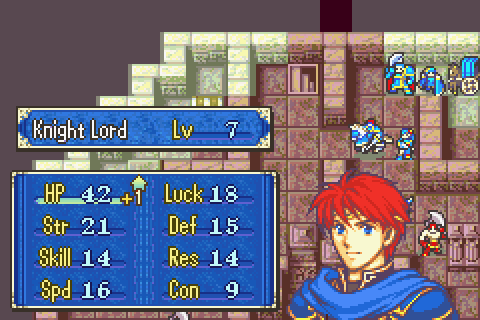 |
| And a deep groan echoed throughout the land... |
Unlike almost every other strategy game, probability in Fire Emblem is
omni-pervasive to the gameplay. It affects a character’s statistical
development, as well as their battle performance (Funfact: in FE5 it even affects basic traversal. A guy can literally move seven times in a turn if the RNG goddess smiles upon you). For those unfamiliar with this franchise, whenever
a character attains a level (by fighting enemies or healing allies), their seven or eight stats have a percent chance of improving.
Other than HP, very rarely will a stat growth rate ever exceed 60%, and
most non-core stats (read: 5/8 of them) will float around or under 30%. Sometimes a character will grow in every stat, other times
they’ll miss a level up entirely, and most often they’ll grow in a couple of
stats and not others. So, level for level, a character’s stats will almost never
be identical between playthroughs (unless the character just has low stat
growth rates in general, in which case they’ll probably be the same as their bases (which is rarely a good thing)).
[For
those wondering, whenever community analysts attempt to compare characters
objectively, they take the averages of that characters’ expected stats at
certain intervals instead of how the character performed on their playthroughs. The hardcore fan axiom for this franchise is thus: "Personal Experience Means Nothing."]
At the same time, combat primarily hinges on percentages,
largely derived from the participants’ statistics. Every attack launched in
combat has a percent chance to hit derived by the basic formula: Accuracy% – Evasion%
= Hit%. If an attack hits then the target takes damage, and if the attacker misses then it fails entirely. In addition to Hit, however, there is also a percent chance
that an attack will score a critical hit dealing 3x the listed damage, which is denoted
by the formula Crit Rate - Target Luck(X) + Y = Crit%; where X and Y vary from game to
game. So, if a character has an insanely high evade rate (typically Swordmasters
& Assassins), then they ostensibly have infinite Defense/Resistance and cannot
die.
There are various in-game systems to mitigate the effects of
stats on the combat (terrain, support, promotion etc.), but the
extreme ends of the spectrum (characters having perfect evasion, and characters
having flawless accuracy) are not only possible, but likely to occur in each Fire
Emblem game.
 |
| Pictured: a Game Boy Advance mere moments before shattering against a wall |
Yet, despite these two factors which would normally
turn the game into a massive crapshoot that no strategically-minded person could take seriously, this
series is still known for its exceptionally high difficulty, precisely because
so much of it is dependent on luck. You can never predict when a situation will go
horribly awry because that one enemy hit off of 10%; because of that one missed growth
that made a character slow enough to get double-attacked and die; because that one
jackass enemy crit off of 1% (or less than 1%). And this reliance on probability is also used in certain
scenarios to make victory itself a matter of luck. A freaking amazing playthrough of Fire Emblem 7 (or just
Fire Emblem here in the west)
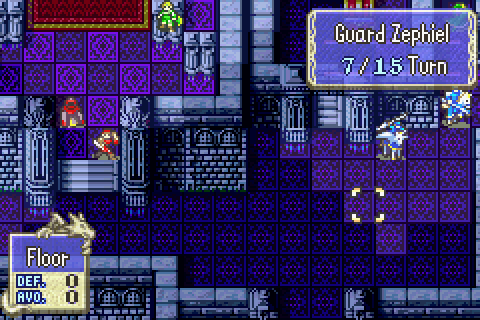
beautifully illustrates this point above. Quoth the Let's Play's textual horror:
“Zephiel [the man in green] will have his first battle on turn 5. No matter how fast you charge down, you will not beat this fighter here. Fortunately, Zephiel has the advantage of being on a pillar and a weapon triangle advantage. When he only has 39 avoid in the first place, though (and that's on the pillar, mind you), that leads to situations like this. Zephiel is nowhere near fast enough to double him [the red guy with the sword] in response, and he won't attack on his own turn, so Zephiel must dodge at least one of the two attacks. Not failing the mission here is literally up to luck.”
So, yes Fire Emblem is hard, but only because the stakes can be extraordinarily high. I suspect that this similarity with gambling is at least partially why this franchise has endured for over 2 decades, however, it doesn’t change the fact that the randomness inhibits the actual strategic component of these Strategy RPGs. Fortunately, the developer has recognized this for quite some time, and over the years have come up with several ways to alleviate this issue.
Most units who join the player’s army will not be at level 1
in a base tier class (as that would make them a liability if they joined any
time beyond the first few chapters), and some will even join “pre-promoted.”
Because pre-promoted units have noticeably less room to grow, their base stats
have to be sufficiently high so as to not be fucking useless wholly outclassed
by non-promoted units. But, in order to keep the non-promoted units whom
the player has likely invested much time and effort in training viable, the
devs have to make sure that the Pre-promotes aren’t too good. Thus, a compromise is struck and pre-promoted units almost
invariably fall into one of two categories: those with slightly below average
base stats and middling growths, and those with decent base stats and decent
growths.
“Zephiel [the man in green] will have his first battle on turn 5. No matter how fast you charge down, you will not beat this fighter here. Fortunately, Zephiel has the advantage of being on a pillar and a weapon triangle advantage. When he only has 39 avoid in the first place, though (and that's on the pillar, mind you), that leads to situations like this. Zephiel is nowhere near fast enough to double him [the red guy with the sword] in response, and he won't attack on his own turn, so Zephiel must dodge at least one of the two attacks. Not failing the mission here is literally up to luck.”
So, yes Fire Emblem is hard, but only because the stakes can be extraordinarily high. I suspect that this similarity with gambling is at least partially why this franchise has endured for over 2 decades, however, it doesn’t change the fact that the randomness inhibits the actual strategic component of these Strategy RPGs. Fortunately, the developer has recognized this for quite some time, and over the years have come up with several ways to alleviate this issue.
Weapons, The Weapon Triangle, and Weapon Effectiveness
In Fire Emblem each unit must equip a weapon to engage in
combat (shocking, I know). Each weapon however, has its own accuracy, power,
critical hit rate, and weight which combine with a character’s statistical
abilities to determine their battle prowess. This allows players to “correct”
some of the weaknesses of a character’s stats, or exploit their strengths in a
combat situation. However, there are limits to which weapons a character can
equip (dictated by their weapon proficiency) as well as how much a weapon can
fix (generally damage and accuracy). A weapon alone isn’t going to magically
make a character faster or raise their defense, for instance (no, we’re not
counting legendary weapons), but it can limit their attack speed and cripple
their evasiveness if it’s too heavy.
However, their are also weapons which are inherently Effective
against certain types of units. Though the specifics of how Effectiveness works
varies from game to game, it basically makes certain weapon do mind-blowingly insane damage when used against certain
enemies. And usually, these advantages make logical sense; bows are Effective
against fliers, heavy spears are Effective against armor knights, halberds are
Effective against cavalry, etc. Additionally, the protagonist(s) of each game
typically receive a weapon (usually a sword) that is effective against both
armor knights and cavalry, which enables them to quickly amass a lot of levels
with minimal effort, and circumvents the downside of being required to field
them in every engagement.
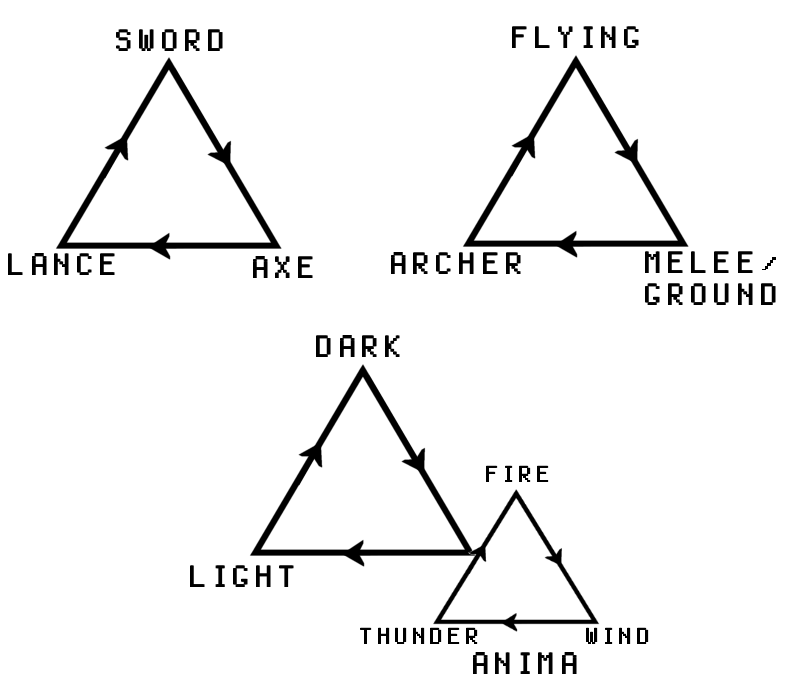 |
| Everything I describe here is a bit simplified, but basically, Fire Emblem could be accurately re-branded as "Game of Triangles" |
Lastly, every weapon class except bows falls into a sort of
rock-paper-scissors arrangement with the others weapons; Swords beat axes, axes
beat lances, and lances beat swords. If a unit engages with an advantageous
weapon class, they will receive a small damage bonus and not-insignificant
boost to accuracy, while the target will simultaneously receive penalties in the
aforementioned areas. As a Fire Emblem game progresses, these bonuses
and penalties eventually become overshadowed by a character’s stats. But, by
exploiting the weapon-triangle, particularly during the early-mid portions of
each game, players can further fix the odds of combat scenarios in their
favor. So in sum, weapon variety alone can circumvent (most) of the issues of
poor stat growths and helps stabilize combat probabilities to make strategic planning in each
engagement possible. However, because players don’t have access to every weapon at
all points in time, the developers still employ several other balancing
mechanisms to supplement the weapons systems.
Pre-Promotes
Every class in Fire Emblem has a level cap of 20. More
pertinently, a unit has up to 19 chances to raise their stats. These classes
are also nearly always divided into two linear tiers. So, when a unit of the
lower tier class reaches at least level 10, a player can use an item to promote
them to the upper tier, immediately granting them large stat enhancements and
extended stat caps so that they might continue their growth and development.
Note: a savvy player will usually prefer to wait until a
unit reaches level 20 before promoting them so as to maximize their growth
opportunities
 |
"Pre-promote" is basically the
series term for badass
|
Why is there rarely an actual middle ground of good-growths and bad bases or
vice-versa? Because, a player almost never receives a pre-promote until at least the
half-way point in the game (with two major recurring exceptions). If a pre-promote had bad bases and good growths, a player probably would't use them because they'd be too incompetent when they joined. Just as well, if a pre-promote had good bases, but bad growths then they would still be so good that there wouldn't be a reason to use another unit of the same class other than preference (which can genuinely matter), or because you want two of them. Regardless of
how, when implemented correctly
(I cannot stress this enough) these units act as yet another "control group" for
the developers, by granting players access to a fixed “backup” unit in case one
of their early ones dies - FYI this series has perma-death - or gets screwed over stat-wise by the random number generator.
*Jeigans, Oifayes, and Radiant Dawn:
A Jeigan is a pre-promoted unit who joins at the start of
the game and has abominably terrible base stats and growth rates (for a
pre-promote), but noticeably superior stats compared to the low level unpromoted
units provided at the time. They are thrown in to help make the early
chapters manageable, and quickly become outclassed and discarded as the other
characters progress - they're essentially "training wheels." However, I’ve seen many a
new player fail to perform this basic bit of mental calculus and use these units to the detriment of their other troops’ growth. So whether or not they actually work seems to be a
bit of a grey area. Although with that said, there are also Jeigans who have
slightly better (though still mediocre) base stats and decent-good stat growths so that they can still be useful later in
the game. These are called Oifayes and, as with Jeigans, are named after the first
character in the series to embody the archetype. The decision of whether to
make a character a Jeigan or an Oifey seems to come down to their combat
ability as stated by the narrative, though they are functionally identical in
the early stages of each game. Also, note that nothing in this sub-section applies to FE10 as that game has three tiers of classes and Bonus Experience, so no unit neatly matches anything stated here.
True Hit
Remember how I said Hit = Accuracy% - Target Evasion%? Well that’s
not entirely true for about half of the
games in this franchise (FE6-12, and probably FE10 (we have yet to confirm it)). The displayed Hit is in
fact the unit’s hit rate, but the game doesn’t calculate whether an attack
actually lands using straightforward arithmetic. To save you non-math people the
numerical horror, basically the further the displayed Hit deviates from 50 (in
either direction), the more harsh the difference in accuracy in that direction.
To take some extreme examples, if a unit has a 15% displayed chance to hit, their
actual odds of hitting are a paltry 4.65%. But, if a unit has an 85% displayed hit chance, their True Hit is actually a more reliable 95.65%. The point of
these blatant lies parabolic accuracy mechanics is to make attacks more and
less likely to hit under more common circumstances, diminishing the impact of
probability on the basic gameplay.
I’m not sure why this was removed in Fire Emblem: Awakening as it
doesn’t make any sense from a player's perspective (just one more thing to chalk up on the "stuff FE:A gets wrong" board). But, if I absolutely had to give IS the benefit of the doubt and assume they were, in fact, NOT staffed by increasingly spiteful subterranean mole-rats, I’d
guess that this was done was to ratchet up the game’s generally low difficulty by increasing the randomness - which is incidentally the worst way to increase difficulty in video games as there's no way for players to address it.
*Additionally, you may also have noticed that the example numbers
used are extremely similar to each other in one respect, so if you are curious as to why that
is, here’s a more complete explanation of how True Hit works. Trust me, it’s
not THAT complicated.
The Wonders of The Tellius Games (Fire Emblem 9 & 10)
In Fire Emblem: Path
of Radiance, every character has a Biorhythm that determines whether they
receive an accuracy and evasion bonus or penalty for the turn. It travels along
a line that progresses turn over turn (so that the player can predict where it
will be in the future), and the variance depends on each specific character (usually,
in line with their personality).
Players could also reduce the randomness of character stat growths thanks to the
inclusion of an optional fixed growth system. This guaranteed a character stat
growths based on which enemies they defeated combined with the character’s
default growths rates.What’s more, there are Bands that characters can equip
to increase their stat growth percentages in specific areas, enabling players to further skew a character’s growths in the direction that they like. It's slightly more complicated than described above, but basically it prevents the potential absurdities of the random growth system, and enables a possible meta-gaming of character progression, making fixed
strategies possible.
[Fans loved this system so much, in fact, that they've even made mods to include it in older games to make them less BS.]
Its sequel, Radiant
Dawn on the other hand, did not include this perfectly sensible system.
But, it solved the same problem regardless through a combination of other subtle
gameplay changes. First off, the characters almost all have base stats closer
to their stat caps (outside of the starting units, you will not see anyone with
5/20 in a core stat). This makes it much more likely for a character to reach their
stat caps quickly in their core stats. That alone would largely solve the issue
of randomness by making level ups less important.
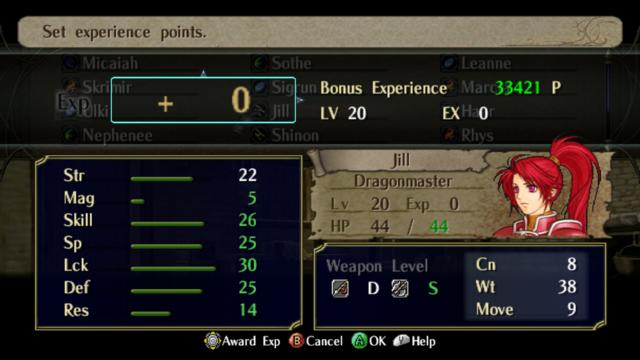 |
| A typical Radiant Dawn stats screen. God, I love this game. And Jill. |
But, IS didn’t settle there, and went one step further in atoning for past sins by granting Bonus Experience a 100% chance of raising exactly three stats when used to level up a character (the three stats chosen tend to follow a
character’s dominant stat growths, for those curious). A savvy player could
thus allow a character to naturally level up and cap out their core stats, and then use Bonus Experience to supplement their weaker areas. Alternatively, if a
character is growing exceptionally poorly naturally, Bonus Experience could
help bring them up closer to par. As with its predecessor, you can still use BEXP to train characters who don’t see much combat if you need to
change up your team composition, and Biorhythm is still intact, so
combat accuracy can still be improved with properly timed attacks. So, ostensibly the issue with probability was effectively solved without removing the series' strong replayability. The series (in theory) had nowhere to go but up, or to the side.
But, despite having devoted so much past effort to making these games more wholly strategic, Fire Emblem: Awakening spits in the face of every fix from the Tellius games, and implements a myriad of
new systems that all run on percentages, making the combat less thoughtful and more random than ever before. But, I’ve already written a long, LOOOONG analysis of that hot mess, which explains this in more
depth, and you don’t need to read another 5600 more words of irate ranting to prove this (hopefully).
 |
| Abilities like Phalanx are why probability isn't an issue in Matsuno's games. Why oh why can't he make a Fire Emblem game? Oh right, Nintendumb. |
With all of that said, however, it needs to be stressed that
probability in strategy games is not an inherently "bad" thing. What’s more, probability
in the areas utilized by Fire Emblem isn’t inherently antithetical to strategy
either. Yasumi Matsuno’s SRPGs (Final Fantasy:
Tactics, Ogre Battle (no, not that one), etc.) for instance, all utilize probability in the
same manner as the Fire Emblem games. Attacks have a % success rate of landing
and characters grow according to percentages dependent on their class. However,
whereas in Fire Emblem the percentages alone dictate the progression of the
game, in Tactics Ogre: LUCT and Final Fantasy: Tactics, the percentages
don’t trend as far into the negative and have a far less profound effect on the
gameplay.
For example, in Final Fantasy: Tactics Advance, every unit has flawless accuracy by default, so every attack would consequently land by default. But to offset this, external abilities, class modifiers, and items grant
characters a fixed amount of Evasion towards physical and magical attacks. This
enabled Square Enix to balance Evasion in isolation to prevent the game
from ever becoming too easy or too difficult. Additionally, whenever a character
levels up, they always gain a fixed amount of stat points in every stat based
on their class, and have a percent chance to gain a specific amount more. In this way, reclassing a character will
always lead to a character progressing as one desires, and occasionally better than one could hope.
So, to answer the question that inspired this Sidequest, nothing is wrong with the probability in Fire Emblem, except for the way in which it was utilized in Awakening. Decreasing the significance of a character’s stats on the evasion rate, and once again making it possible to directly control stat growths in some way would absolutely solve any and all issues with the basic Fire Emblem gameplay…so long as they don’t add any other extreme percentage based bullshit to fill the void. Here's hoping Fire Emblem: iF (or whatever they end up calling it) doesn't follow in Awakening's footsteps.
So, to answer the question that inspired this Sidequest, nothing is wrong with the probability in Fire Emblem, except for the way in which it was utilized in Awakening. Decreasing the significance of a character’s stats on the evasion rate, and once again making it possible to directly control stat growths in some way would absolutely solve any and all issues with the basic Fire Emblem gameplay…so long as they don’t add any other extreme percentage based bullshit to fill the void. Here's hoping Fire Emblem: iF (or whatever they end up calling it) doesn't follow in Awakening's footsteps.
No comments:
Post a Comment