 |
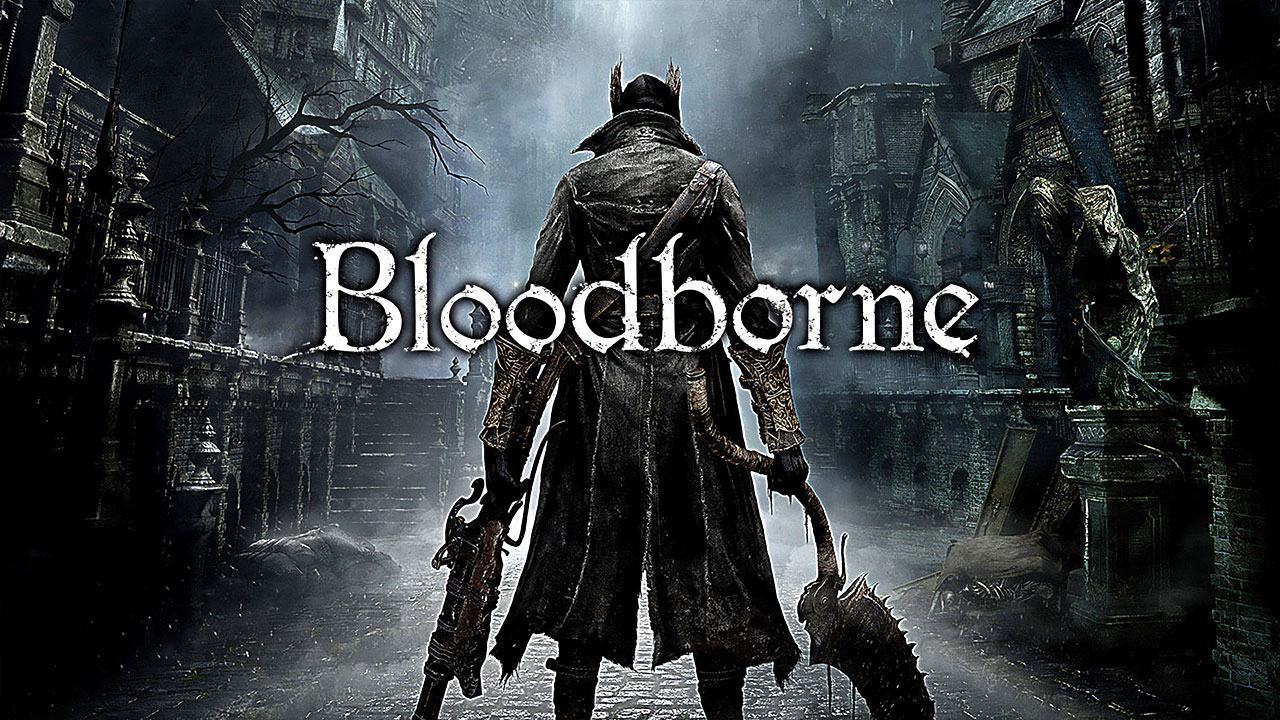
| Welcome to Yharnam |
Ever since I played Dragon
Age: Origins back in 2009, I’ve always taken care to do some research on
the numbers behind every RPG I’m interested in before actually purchasing it.
This was originally done to avoid having to deliberate over every single level
up and item I acquired in the actual game. However, later on, it served the
incidental purpose of allowing me to (at least partially) assess the quality of
the game’s mechanical soundness - how balanced the game is, so as to judge
whether or not I should even buy the game in the first place. So, as with the
two Souls games before it, I took a look at Bloodborne’s
numbers and deemed that it was absolutely functional in terms of its character
progression and items.
But, while I was scouring the Internet for information and
building my tools to help analyze all of the game’s data last week, I also
noticed quite a bit of community backlash that seemed to betray the 92/100 average rating the game has garnered on Metacritic. Doubly curious was the fact that
most of these disappointments seemed to stem from the (apparent)
failure of the title to meet the expectations set by 2011’s Dark
Souls. So, for tonight’s post, I’d like to offer my pre-game theory as to why
the insistence on comparing Bloodborne to Dark Souls in particular is a bit fallacious.
 |
| The Threaded Cane switches between a sword and a serrated whip. It is, naturally, my chosen starting weapon. |
 |
| Sidenote: I love how this game openly mocks the BFS trope endemic to Shonen anime |
However, despite the lower total amount of weapons, the boss weapons of Demon’s Souls allowed for greater build variety in terms of weapons than both Dark Souls and its sequel. Though both Dark Souls and Demon’s Souls follow a trend of making the boss and unique weapons wholly distinct from the standard fare, in Dark Souls most of the boss weapons are gimmicky such that only a handful are actually viable in a build, whereas in Demon’s Souls nearly all of them allow for specific builds, encourage new playstyles, or have a special utility (e.g. The Large Sword of Searching increases the item drop rate). Of particular note there is no:
Talisman of Beasts - enables utilization of the entire
spell pool, regardless of one’s magic stat
Blueblood Sword - allows for balanced builds that use the
normally neglected Luck stat
Northern Regalia - a powerful stat-agnostic magical weapon
Phosphorescent Pole - constantly Regenerates MP for more sustained spell
casting
Meat Cleaver – a heavy weapon with high mixed melee stat
scaling
Scraping Spear - devastatingly effective for PVP, but
mediocre elsewhere; an anti-invasion tool.
Lava Bow - A ranged elemental weapon, acquirable early on, with
cheap ammo, and low stat requirements.
Morion Blade - Drastically raises power when low on health and combinable with other similar tools.
Baby’s Nail - A reusable means of inflicting horrific status ailments (literally
called “the plague”)
Istarelle - Means of negating most status ailments, while also inflicting high magic damage.
or
Dark Silver Shield - General purpose light shield that completely
nullifies magic regardless of stat investment.
None of these have equivalents in Dark Souls, nor is there a
comparable assortment of new weapons to replace them in the standard game [Note: the Dark Souls DLC that was released a little over a year later amends this somewhat by adding several weapons with
similar functions to some of these Demon’s Souls weapons]. And that isn’t a
criticism of Dark Souls.
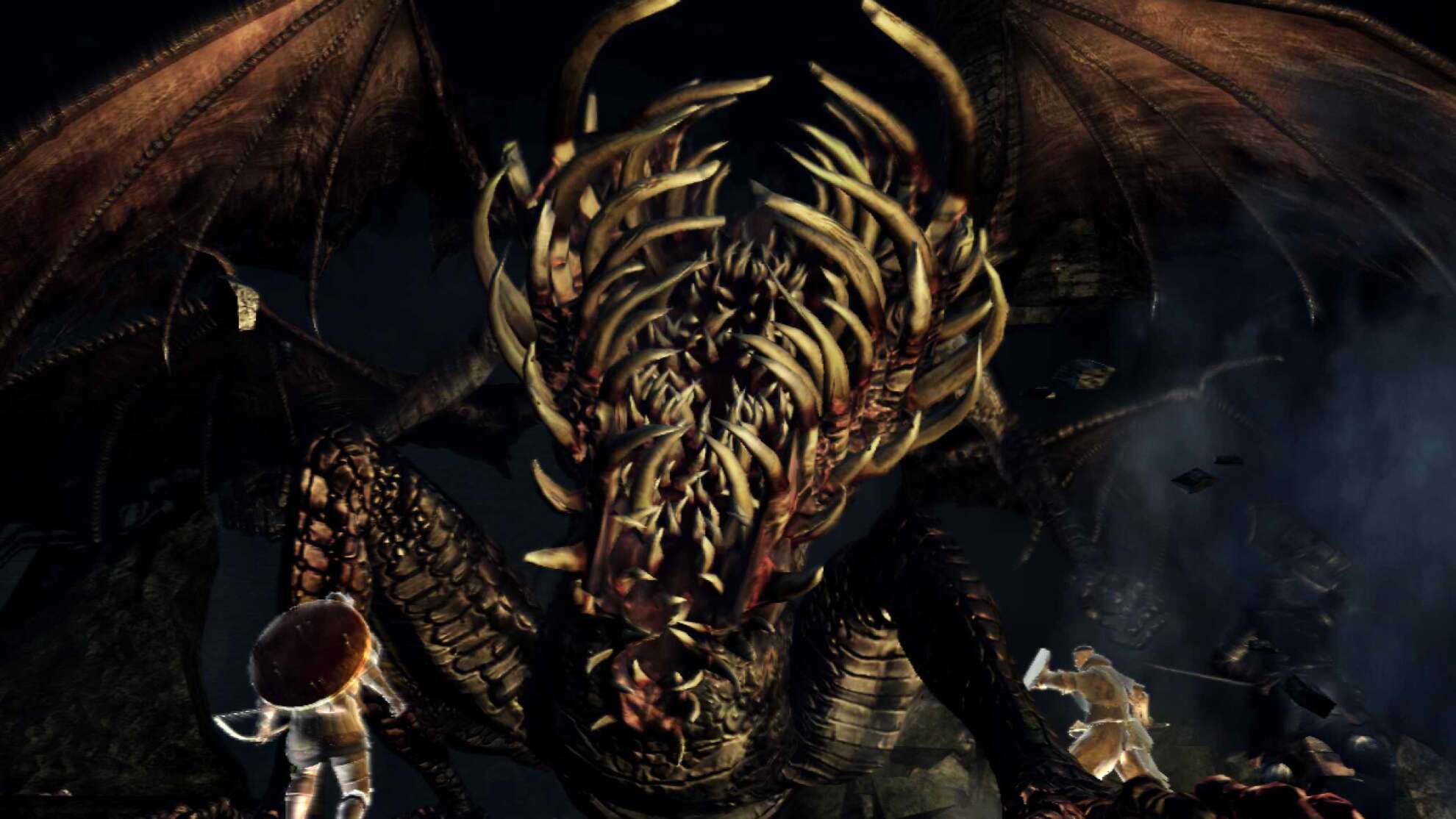 |
| Dark Souls: "$#&@% THIS!!!!!!!!" |
In a game where you are expected to overcome increasingly
harrowing adversity using the (seemingly) inadequate tools at your disposal, having
a more limited (usable) arsenal for most of the game helps inspire the
emotional high achieved from defeating a boss, or reaching a bonfire after a desperate, harrowing venture. In this sense, the game’s limitations help immerse the player
into the game’s story, and is largely what inspired the annoying as hell
community slogan “git gud.” In Demon’s
Souls however, none of this is
applicable.
Clearing bosses and worlds can either be like beating your head against a wall OR taking a casual stroll through a sunlit park, entirely based on how you approach them
and what tools you bring with you. This is why the Thief Ring (a reliable means
to repeatedly avoid combat entirely) is available in the first area of the game
AND again later on; why the Ring of Regeneration, Lava Bow, and Crescent
Falchion +1 are all available in the first area of one of the game’s worlds (i.e.
accessible almost immediately upon starting the game). Skill and perseverance
do not matter in Demon’s Souls, only
victory regardless of how it is achieved. If Dark Souls is a game about perseverance, then Demon’s Souls is about craftiness and creativity.
 |
| Demon's Souls: "Pffft, life threatening danger is for tryhards." |
Versatility in terms of player character creation and specialization
was priority number one in Demon’s Souls,
so rather than containing a large weapon pool partially composed of figurative junk
to sift through, they combined the functions of two different weapons into one
while still retaining the two weapon slots (functionally allowing for 4 weapons
in total). They also lowered the overall stat requirements of nearly every
weapon and made one (of the three) versions of nearly all weapons acquirable around
the start of the game, thus allowing players to use most of the game’s arsenal
with almost any (sensible) stat allocation. And the list of Demon’s Souls expansions goes on and on,
from the expansion of the gothic architecture to the new repeatable randomized
areas separate from the story. So, as has hopefully become apparent by now, Bloodborne is not Dark Souls 3 or a
wholly new property; Bloodborne is
Demon’s Souls 2.
 |
| "Challenged" = Scared shitless |
But with that said, through Bloodborne’s removal of shields, addition of Visceral Attacks (forward
counter attacks), and hastening of the enemies, From Software also made the
utilization (or at least understanding) of the player’s expanded toolset more
important than ever. Unlike in Demon’s
Souls, player skill is now a factor. And yet, the player is still in the
same overarching role (i.e. greedy bastard) that they were in Demon’s Souls, so piecing together the
context of the game’s prior events through loot isn’t all that important
either. What results is a game that is specifically targeted at people who like
a challenge and expressing themselves through the diversity in the combat,
which granted, was an element of both Demon’s
Souls and Dark Souls (and likely
the strongest contributor of their extended longevity), but not quite the focus
of either game like it is here. So, even though Bloodborne is ostensibly a sequel to Demon’s Souls that could only really exist after the creation of Dark Souls, the game is alienating to
some fans of the games that preceded it. Note however that this was true of
both of predecessors as well.
 |
| One of the biggest mysteries, tragedies, and thrilling tales of Dark Souls. You'll get no spoilers from me. |
For instance, I absolutely loathed Dark Souls when it first came out. In patch 1.00, the game frankly seemed too hard due to the dearth of souls dropped by enemies (as well as my insistence on playing it like Demon’s Souls without a shield), and the cohesiveness of the world, ironically, made the combat feel unrewarding as after every boss battle you were instantly
reminded that your victories were fleeting and marginal - “things always get worse.” However, as the game progressed, I became
sufficiently skilled at it so as to not notice the combat at all. Instead, I
shifted my attention to the mysterious story gradually unravelling through the
items I found and NPCs I met. Eventually, the exploration became the only thing
I was interested in, and compelled me to see the game through to the end with a
different sort of appreciation than I had for Demon’s Souls. Currently, the game is far easier and more
accessible to newcomers, so my old issues shouldn’t be a problem for anyone now,
and I’ve had nothing but an exceptional time replaying it since then.
It’s worth noting however that this new interest also led me
to hate Dark Souls 2 (a topic for
another day), as its story was
irredeemable nonsense, and the gameplay still wasn’t enjoyable (read: fair) or
refined enough to carry the experience. But, as I’ve already stated, Bloodborne has taken quite a few steps
to make the combat more active and engaging, so if its story does end up
letting people down, perhaps it won’t matter so much.
For those reading this who dislike Bloodborne, maybe you will find something else about the game to
enjoy as well. But if you don’t, that’s fine too. It’s a different game
offering a different experience than every game before it.
No comments:
Post a Comment